The following is from the original program book for Quo Vadis.
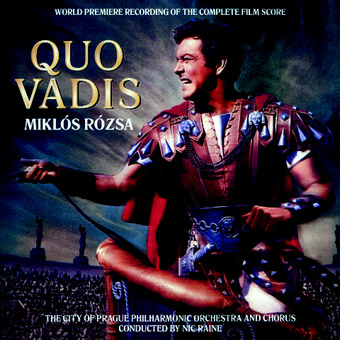
The musical score which Dr. Miklos Rozsa, brilliant two-time Academy Award winner, has created for “Quo Vadis” is expected to set a whole new pattern for the scoring of historical films.

In the first place, although there is no record of exactly what kind of music the ancient Romans enjoyed, the tunes used in the production are believed to be as nearly authentic as possible. The song that Nero sings during the burning of Rome, and the hymn the Christians chant as they are martyred, are most likely a close approximation of the real thing. At least Dr. Rosza doesn’t think they differ more than a few notes from the compositions sung by the emperor and his people.
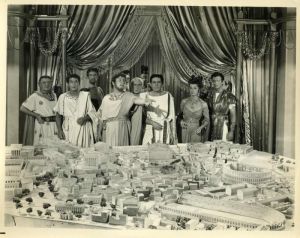
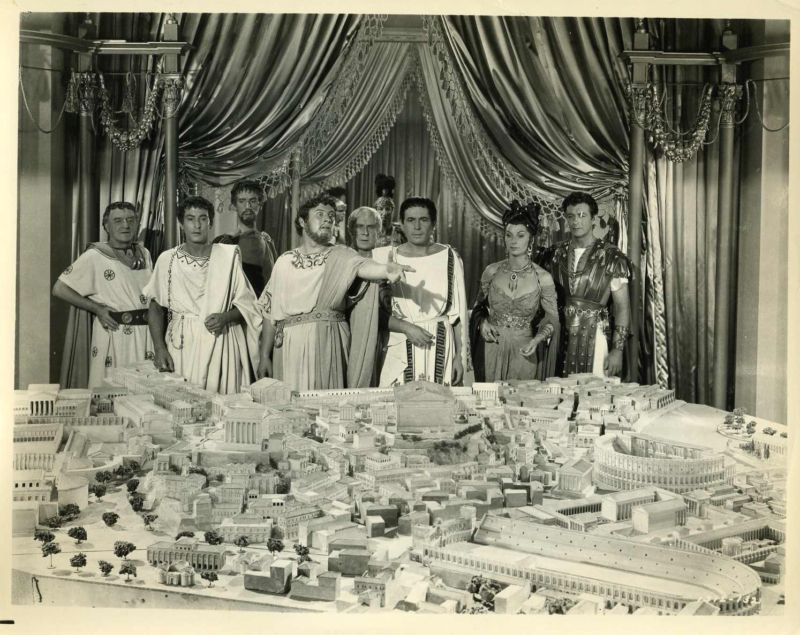
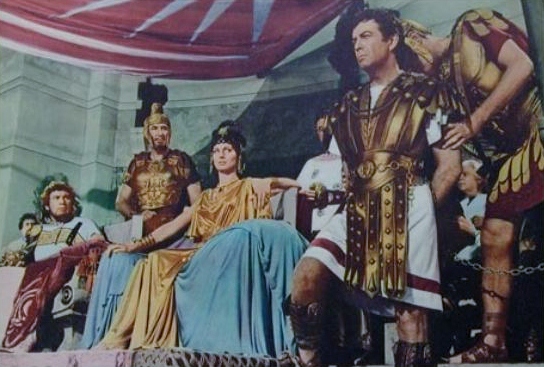
Nero contemplates his greatest source of inspiration–the upcoming burning of Rome.
Rosza preceded his work on the film with many months of careful research. To evolve the songs of 2,000 years ago he and Hugh Gray, who wrote the song lyrics, went back to the Greeks who left written records of some of their songs. Both Rosza and Gray are agreed that these undoubtedly influenced Roman music. They point out that mostly the music was liturgical, with numerous written in praise of Mars, Jupiter and other pagan gods.
Acords to Rosza the Romans obtained musical rhythm by the use of words. Therefore, he simply had to study Greek poetry in order to get an idea of the beat of the music. In writing the score he followed three main lines: use of Greek influence for music involving Nero, Marcus and other personalities; use of old Hebrew melodies (which actually became the basis for the early Roman Catholic Church ritual) in the religious scenes; and finally, the use of martial music based on Greek and Sicilian melodies, in the scenes involving the military.
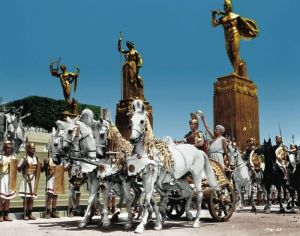
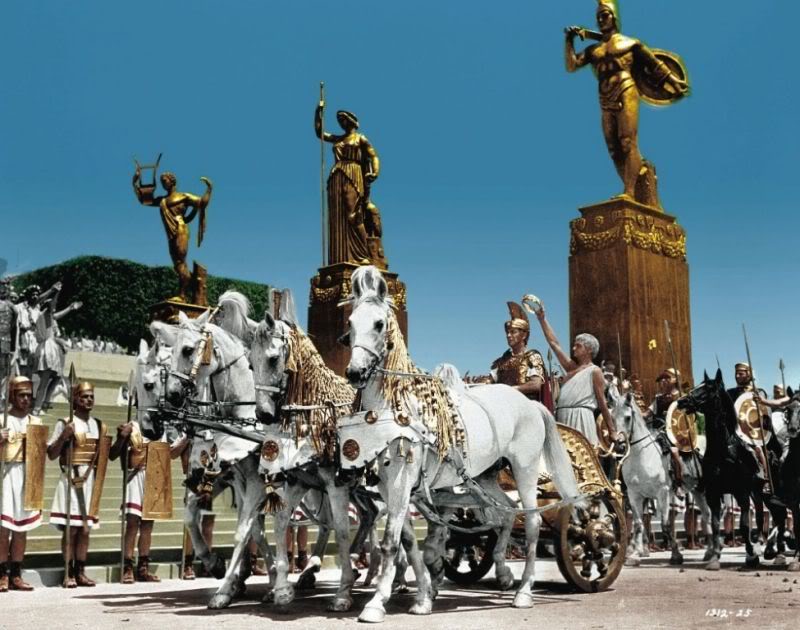
Fanfares on various types of horns accompanied a triumphal procession.
Failure of the Romans to leave a record of their music did not, it seems, prevent modern man from discovering exactly the type of musical instruments they used. The pottery, statues and paintings passed down from this ancient period contain reproductions of men and women using the aulos (a double flute); the salpinx (a long trumpet); the buccina (forerunner of the modern horn); the lituus (a long brass pipe) and other rare instruments. These even include the bagpipe which historians agree actually was introduced into Scotland by ancient Roman soldiers.
For use in Quo Vadis, copies of all these instruments, including the bagpipe were made in Italy.

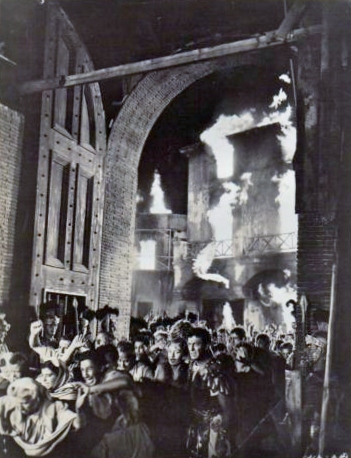
Rome burns accompanied by Nero on the lyre–omnivorous fire.
Rosza declares that the only real thing in the music line on which he has done any real improvising is in the matter of harmonization. He points out that music of 2,000 years ago ws entirely homonophonous (lacking in harmony) and everything had to be played or sung in unison. Actually harmony was not evolved until 700 years later.
The Christians in Quo Vadis, according to the composer, do sing their hymns in harmony, although he offers assurance that they have not gone so far as to use four-point harmony while being devoured by the lions.
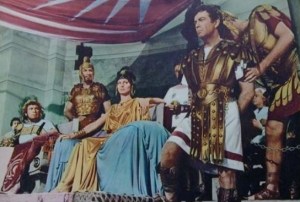
The Christians sang in the arena–in harmony.
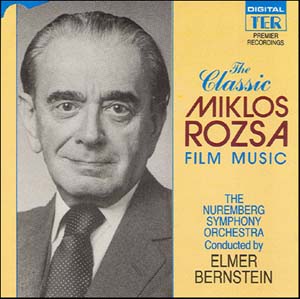
Dr. Rosza. who holds a professorship in film music at U.C.L.A. and who is recognized as one of the brightest musical talents on the Hollywood scene, has been composing for films since 1936. A native of Hungary, he has made his home in Hollywood since 1941. His scores for Spellbound and A Double Life won Academy Awards, and in addition he composed the music for such notable films as The Lost Weekend, The Killers, and Naked City.




 Robert Taylor Actor