Valley of the Kings, 1954, is playing on Turner Classic Movies on Thursday, September 9 at 12 noon. This is another of my favorite Taylor pictures–he never looked sexier than he does here. Mark Brandon, the ruggedly handsome archaeologist played by Robert Taylor is thought to be the inspiration for Indiana Jones.
This is one of my favorite Robert Taylor pictures. Eleanor Parker and he had wonderful chemistry and both of them looked their best in this exotic action-adventure film. The following is my review for the IMDb.
This isn’t a serious or “meaningful” film. It is pure entertainment, beautifully photographed on location in Egypt. The stars, Robert Taylor and Eleanor Parker, had great chemistry both off-screen and on. Taylor manages to be glamorous even when trapped in a sandstorm. The plot is relatively thin with Parker seeking to validate part of the Old Testament by finding the tomb of the Pharaoh who reigned in the time of the Biblical Joseph. She bats her eyelashes at Taylor who comes along happily. Then she introduces her husband, Carlos Thompson. There are horse and carriage chases, murders, the aforementioned sandstorm, a spectacular fight at Abu Simbel, a scorpion attack–all in ninety minutes. Given the slower pace of movies in the 1950s, there is also time for Taylor and Parker to discover each other more thoroughly (over some fermented goat). Egyptian belly dancer Samia Gamal shakes her stuff at the demure Parker. Highly enjoyable.
One of the best screen kisses ever!
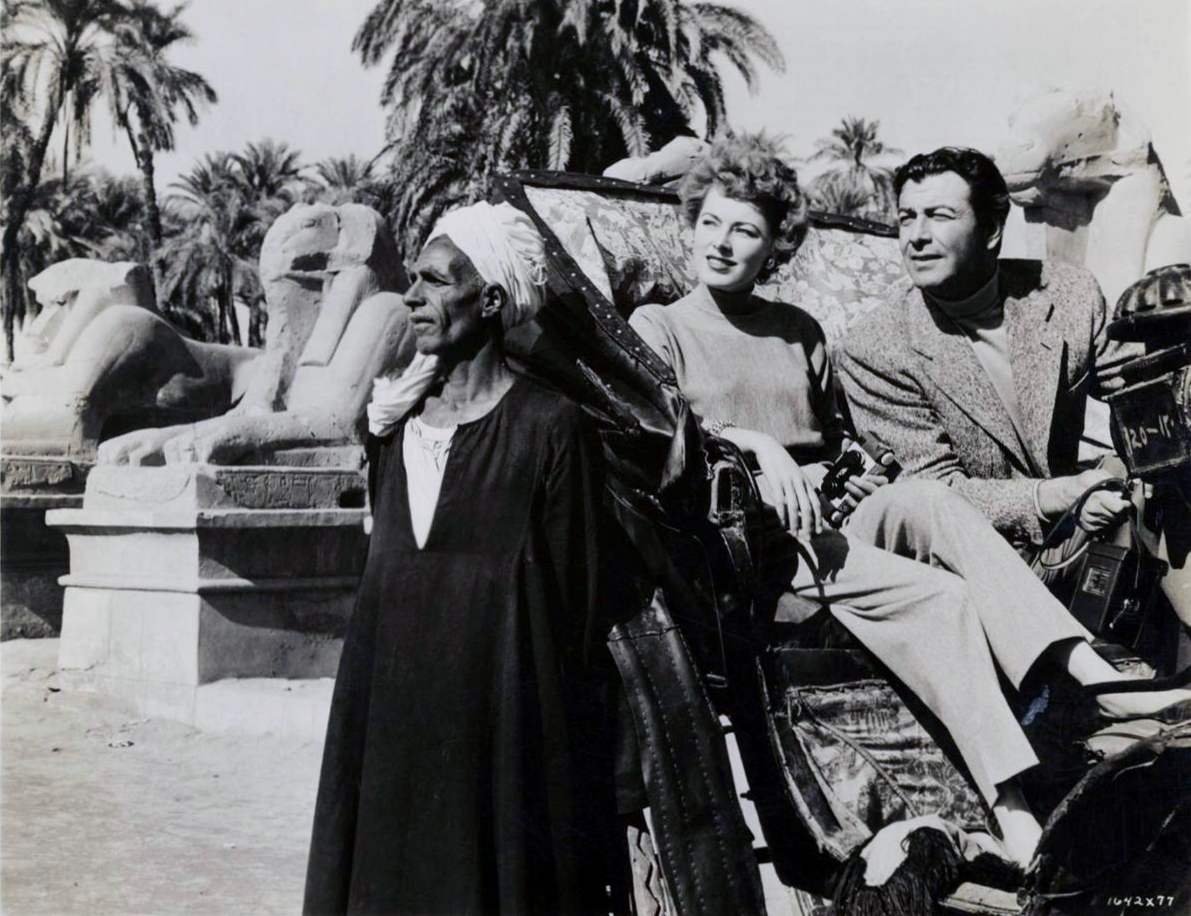
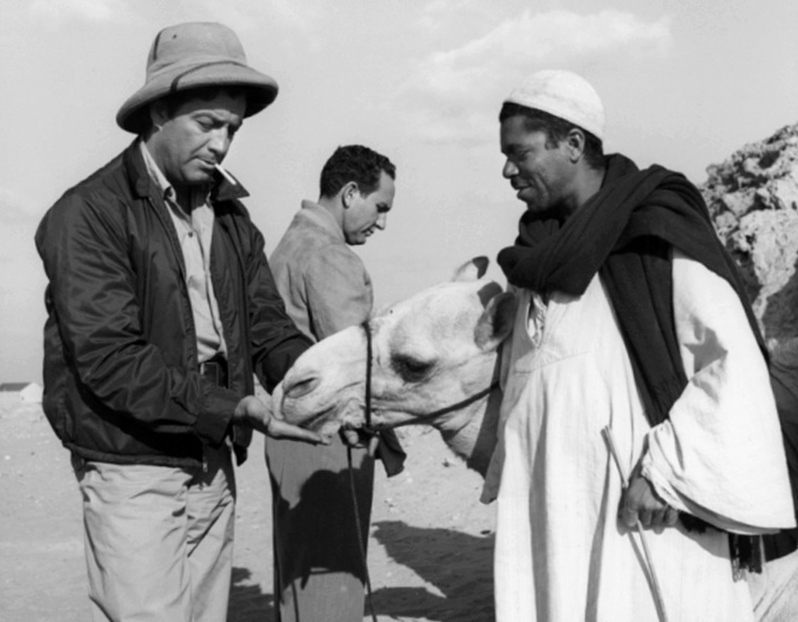
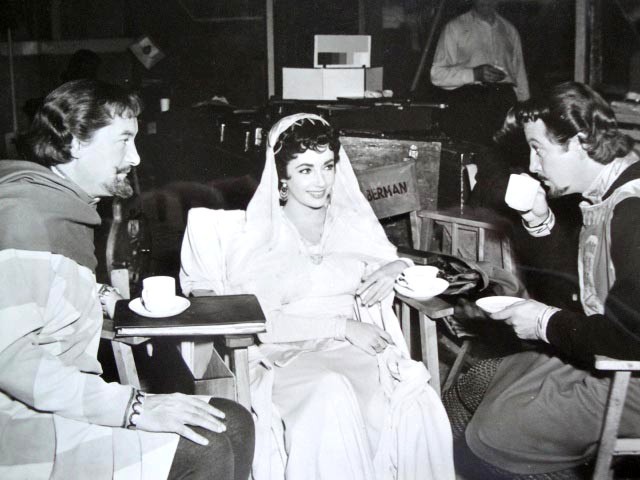
Some behind the scenes photos:
Robert Taylor horsing around with a donkey and Eleanor Parker
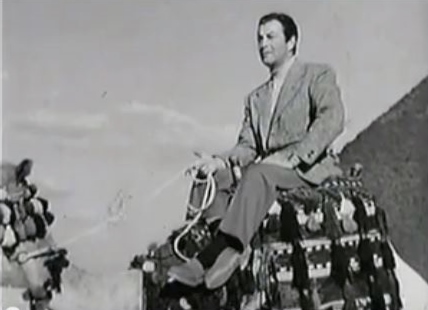
Looking insecure on a camel.
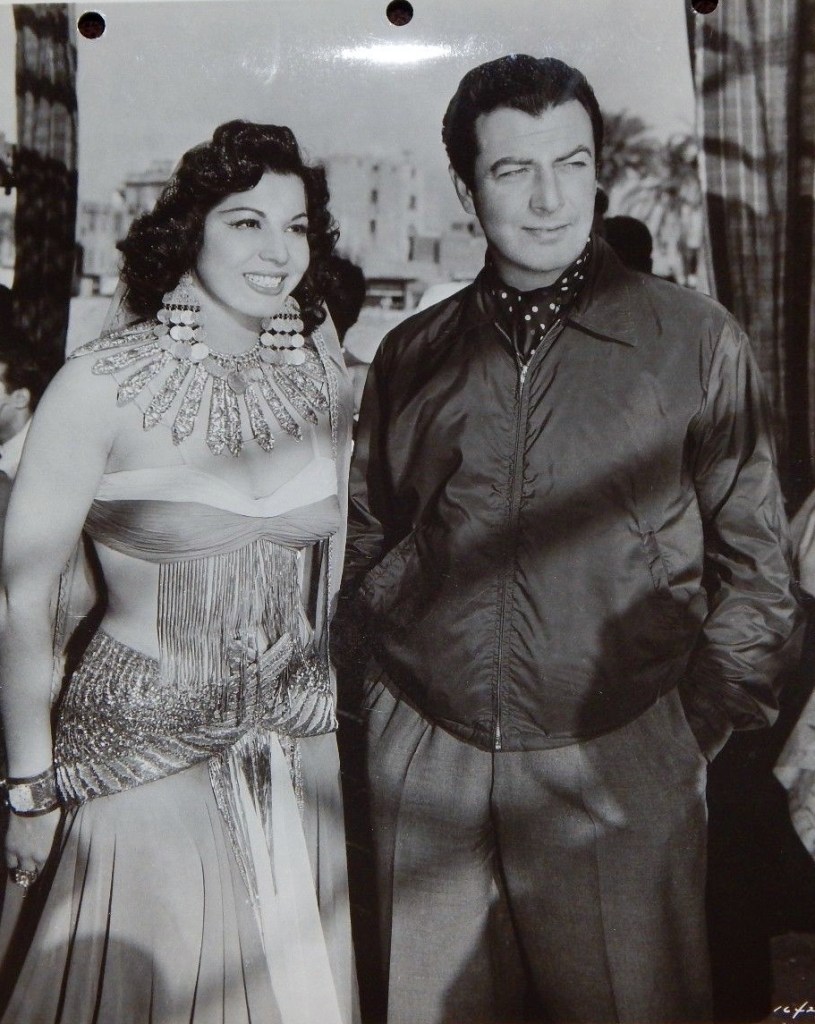
Famous dancer & star. SG, celebrated oriental dancer, is pictured w. RT on set of MGM’s VotK in Egypt. She dances in film while T has romantic w. EP. It is Miss G’s first appearance in a Hollywood production.
With Kurt Kazsnar and Carlos Thompson.
Eleanor Parker, Robert Taylor, Robert Pirosh.
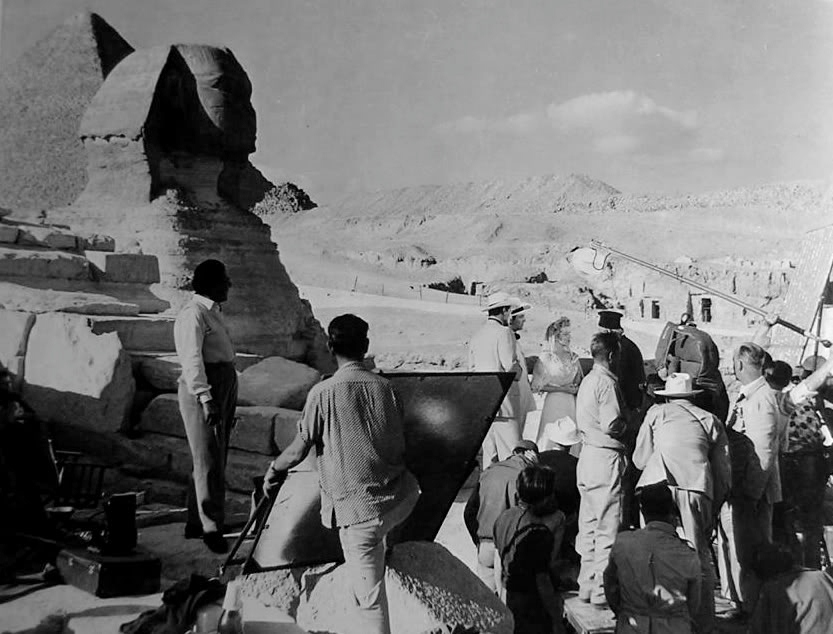
At the Sphinx.
Eleanor Parker and Robert Taylor at the Mena House Hotel.
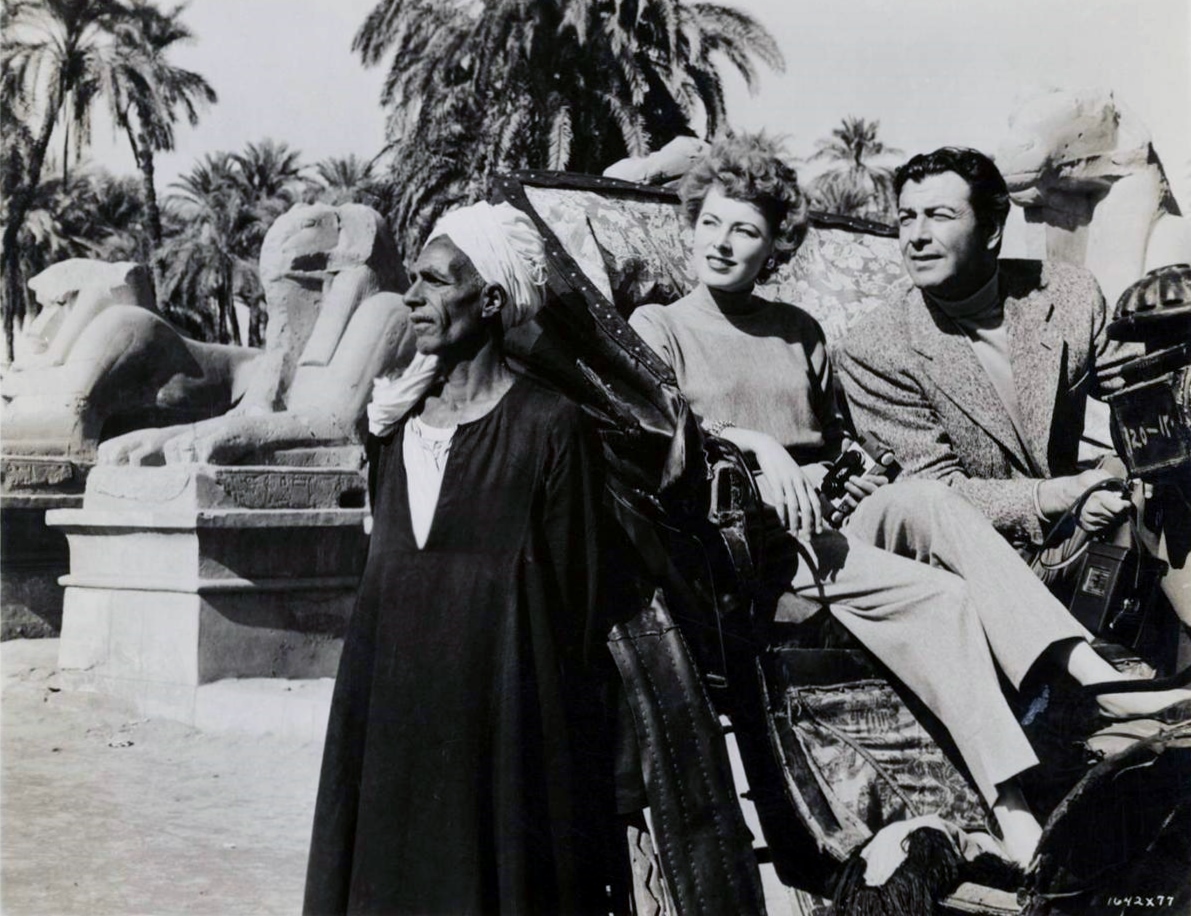
Touring by Carriage.
Mr. Taylor meets a camel.
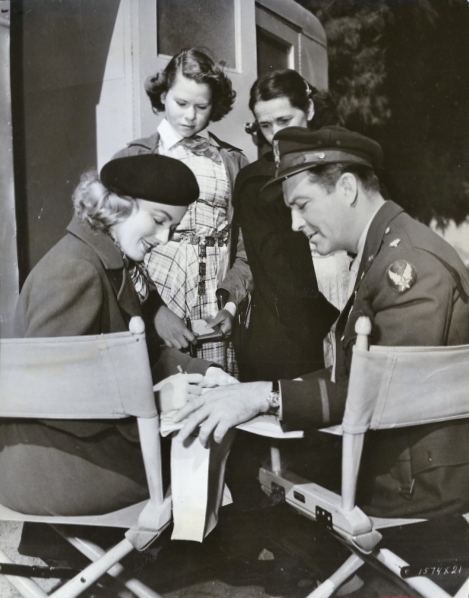
Actress Eleanor Parker, on her knees, helps Robert Taylor, dressed up as an archaeologist, to lace up a boot on the set of the movie ‘Valley of the Kings’. Egypt, 1954. (Photo by Mondadori Portfolio via Getty Images)
Mr. Taylor injured his knee jumping off a camel and may have had difficulty lacing his boots. They both look happy about it.
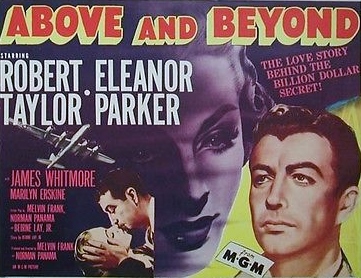
Above and Beyond, 1952 is playing on Turner Classic Movies on Thursday, September 9 at 6:30 a.m. This is one of several roles for which Robert Taylor should have won an Oscar. He was outstanding.
Larry Keating and Robert Taylor
Considering that Above and Beyond was made during the height of the hysteria now known as McCarthyism, one would have expected a jingoistic flag-waver out of Hollywood. Instead, surprisingly, the screenplay as written allows the Paul Tibbets character (Robert Taylor) the opportunity to register a variety of emotions, in a most realistic and compelling performance.
This is ironic, seeing as the real Tibbets, decades after the event (the bombing of Hiroshima), is to this day unrepentant. Not to criticize his position in any way, because that was a different time and place, and it’s Tibbets’ view that he had a job to do, and the morality of it all, he has stated, is best debated by others.
Robert Taylor and Eleanor Parker
But the film is all the more compelling because of the ambivalence written into the Tibbets character, and Taylor’s especially fine work. There are uniformly strong performances throughout the cast, notably those of Eleanor Parker (Lucy Tibbets), James Whitmore (the security officer) and Larry Keating (General Brent).
Another surprise: the team of Melvin Frank and Norman Panama (screenplay, direction) had been best known for their Bob Hope comedies, when under contract at Paramount. Their first dramatic effort was “Above and Beyond,” and they acquitted themselves admirably.
Final note: the musical score by Hugo Friedhofer is immensely satisfying: stirring in an emotional sense, with just a touch of, but not too much of, militaristic flavor.
Dore Schary, a Democrat, had succeeded fervent Republican Louis B. Mayer at MGM in 1951, and had encouraged the production of Above and Beyond. One wonders if (a) the film would have been made at all on Mayer’s watch, and (b) if it had, would it have been more of a cornball, John Wayne-type flag-waver. Thankfully, those questions are moot. “Above and Beyond” is a stirring, finely-crafted film. I would stress again the unusual nature of the protagonist’s ambivalence as portrayed in a film made during a very sensitive time in America’s history. Review by Alan Rosenberg, Toronto, Canada for the imdb.
Note: I don’t agree with some of this reviewer’s comments but I thought the review is worth reading. Judith
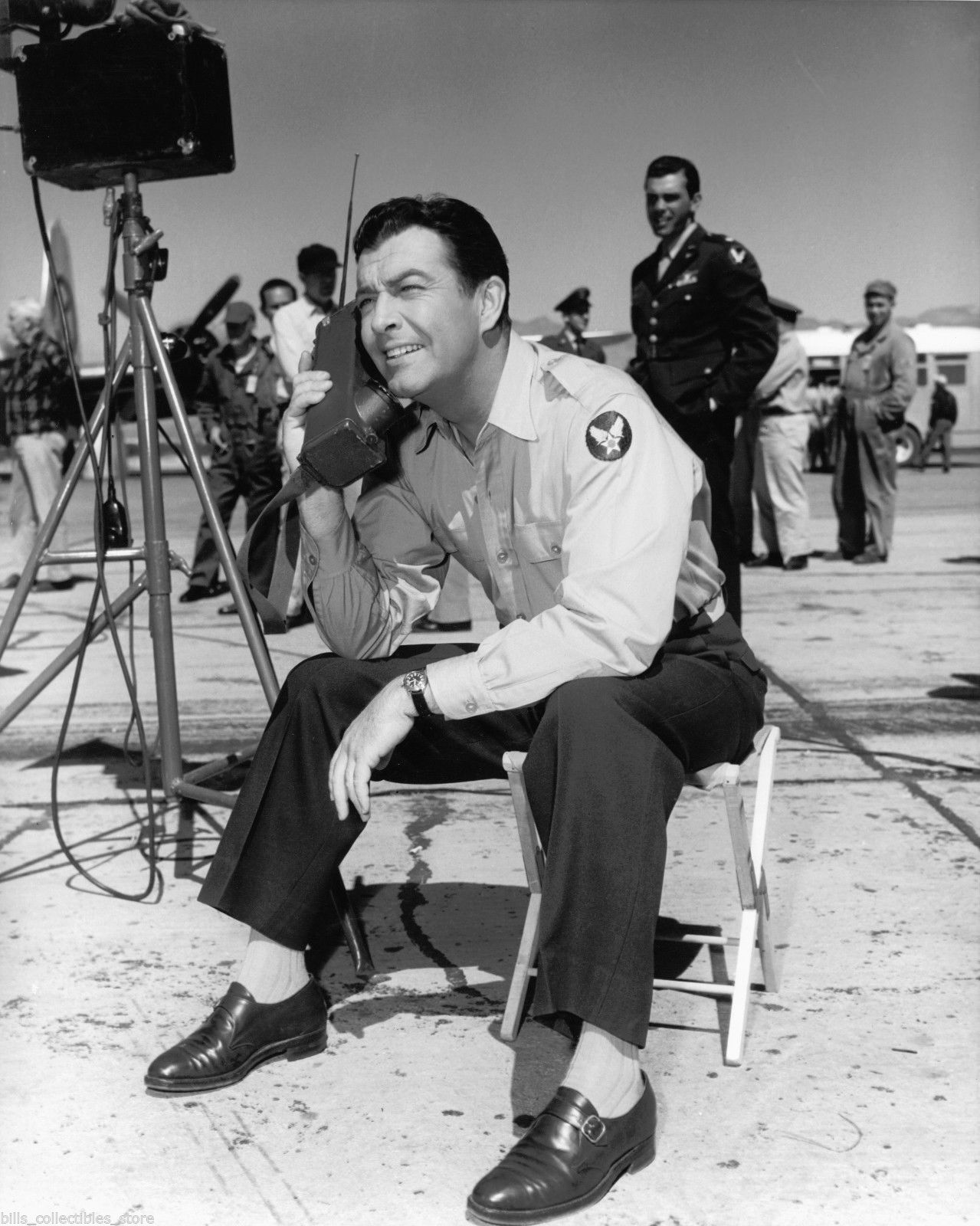
Some behind the scenes photos:
Actor Robert Taylor, seated on a chest, entertains his colleagues Eleanor Parker, Ricardo Montalban, Jonathan Cott and James Whitmore during a break from shooting the movie ‘Above and Beyond’. USA, 1952. (Photo by Mondadori Portfolio via Getty Images)
Ivanhoe, 1952, is playing on Turner Classic Movies on Monday, September 6 at 2 p.m.
Ivanhoe was one of the most successful films of the year and brought in over $10 million at the box office, about $89,823,018.87 in 2015.
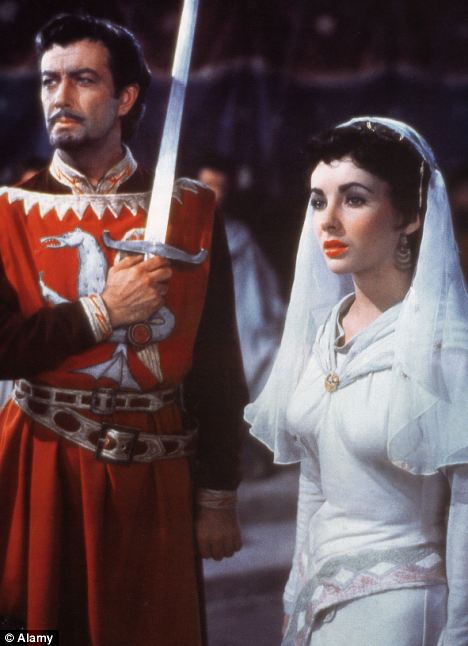
Robert Taylor and Elizabeth Taylor in Ivanhoe.
Wonderful movie! This film is an exciting adventure-romance which never once loses its pace or feel. Robert Taylor brings depth to a potentially dull lead character. Jean Fontaine is great as his love, the Lady Rowenna. Elizabeth Taylor, though, steals the show with her stunning portrayal of Rebecca of York! This film has aged very well and shows first-hand to a young generation just why Elizabeth Taylor was such a star.
Although this film is an extremely enjoyable adventure, it also has the guts to tackle some complicated issues and resolve them in a very non-Hollywood fashion. As Ivanhoe feels his love for the beautiful Rebecca grow will he defy convention and pursue the lovely Jewish girl or remain with the safe charms of the blond, Anglo-Saxon Rowena? The answer is intelligently handled and surprising. This film is one of the greatest examples of the classic adventure. Review by David Arbury for the IMDB
Here are a few behind the scenes photos:
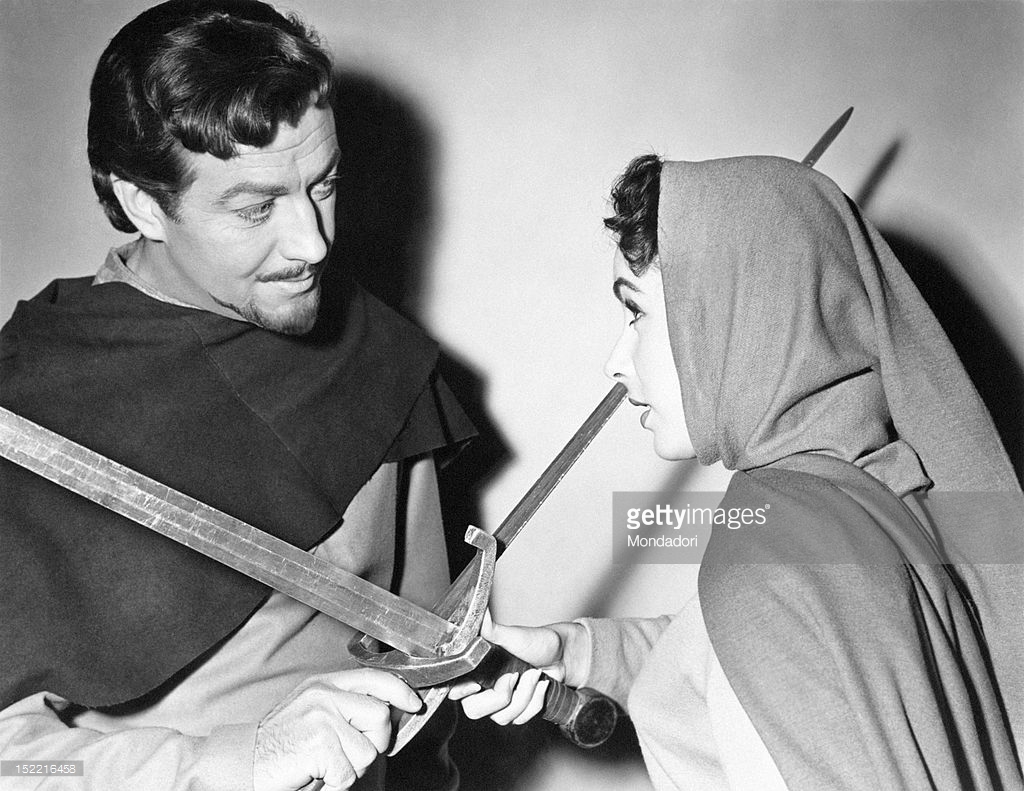
Robert Taylor and Elizabeth Taylor
George Sanders, Elizabeth Taylor, Robert Taylor
Robert Taylor, Joan Fontaine, Richard Thorpe (dir.)
Camille, 1936, Is Playing on Turner Classic Movies on Sunday, September 5 at 6:00 a.m. This is the love story of all love stories and shouldn’t be missed.
This film further proves that the assembly-line system of Hollywood studios back then should also be taken seriously in terms of artistry. Just because movies were produced run-of-the-mill doesn’t mean that they weren’t paid critical attention to by their makers. The usual impression on studio-era Hollywood is: take a formulaic narrative style, maybe adapt a stage play for the screen, blend in a handful of stars from the stable and the films rake in the profit at the box office. Not quite, that’s the easy perception. George Cukor, another of those versatile directors, made it apparent with Camille that filmmaking as an art may still flourish despite (and even within) certain parameters. Camille is beautiful, in so many respects. And it’s not just because of Greta Garbo.
Sure, the acting is amazing, the casting is perfect. Garbo is luminous, mysterious, cruel, and weak at the same time. Robert Taylor surrenders himself to be the heartbreakingly young and vulnerable Armand. Henry Daniell’s coldness and sadism is utterly human and familiar. The others are just plain wonderful. The writing contains so much wit and humor, devotion and pain – but it never overstates anything. The rapport and tensions between lovers, friends, and enemies are palpable and consistent. The actions flow so naturally, just like every scene, that checking for historical inconsistencies seem far beside the point.
here is so much that I love about Camille that it’s hard to enumerate them all, but with every little discovery comes the realization that this is “but” a studio production, so it makes the experience more exquisite. Camille is a gentle, poignant romantic movie that, like Garbo, takes its place delicately and self-effacingly in the history of American cinema, but makes itself indelible in the heart and mind of the lovelorn individual viewer. Review by tsarevna for the IMDb.
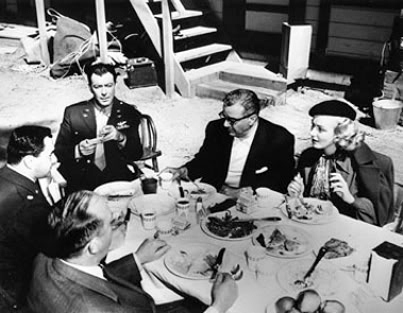
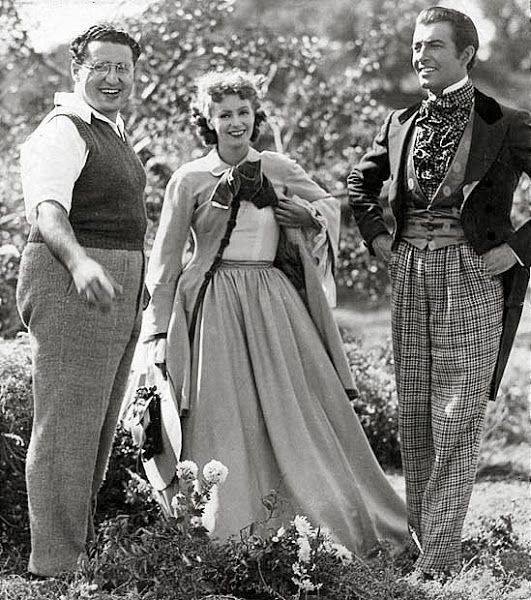
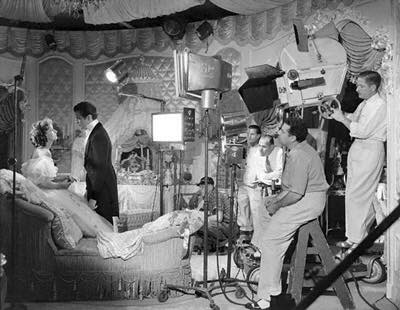
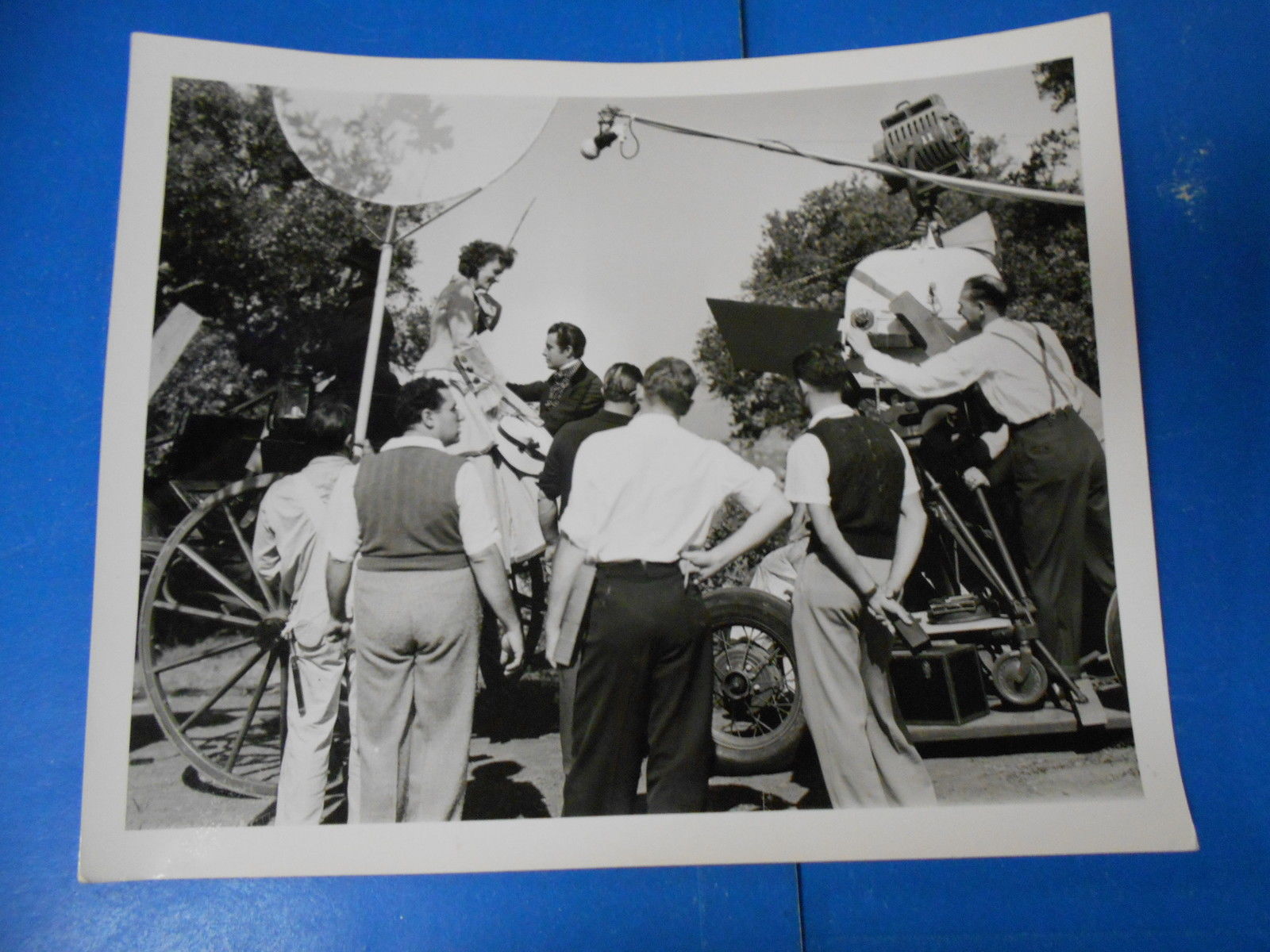
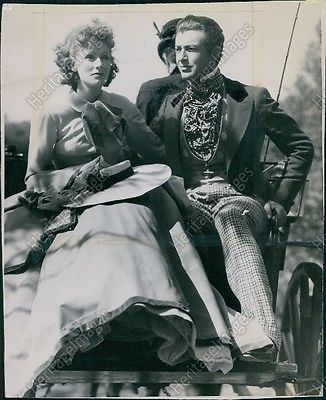
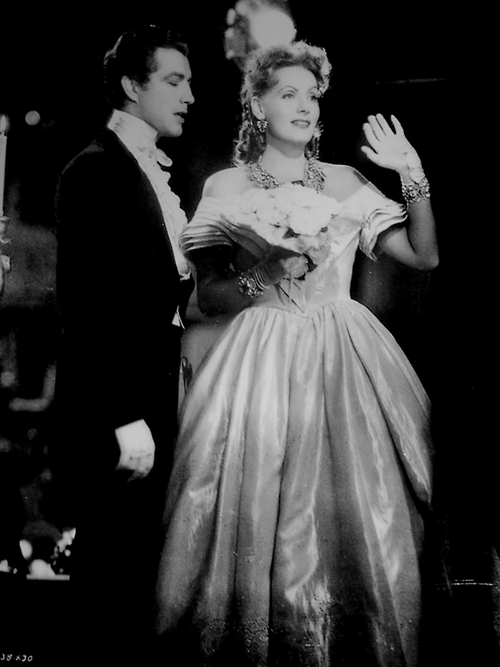
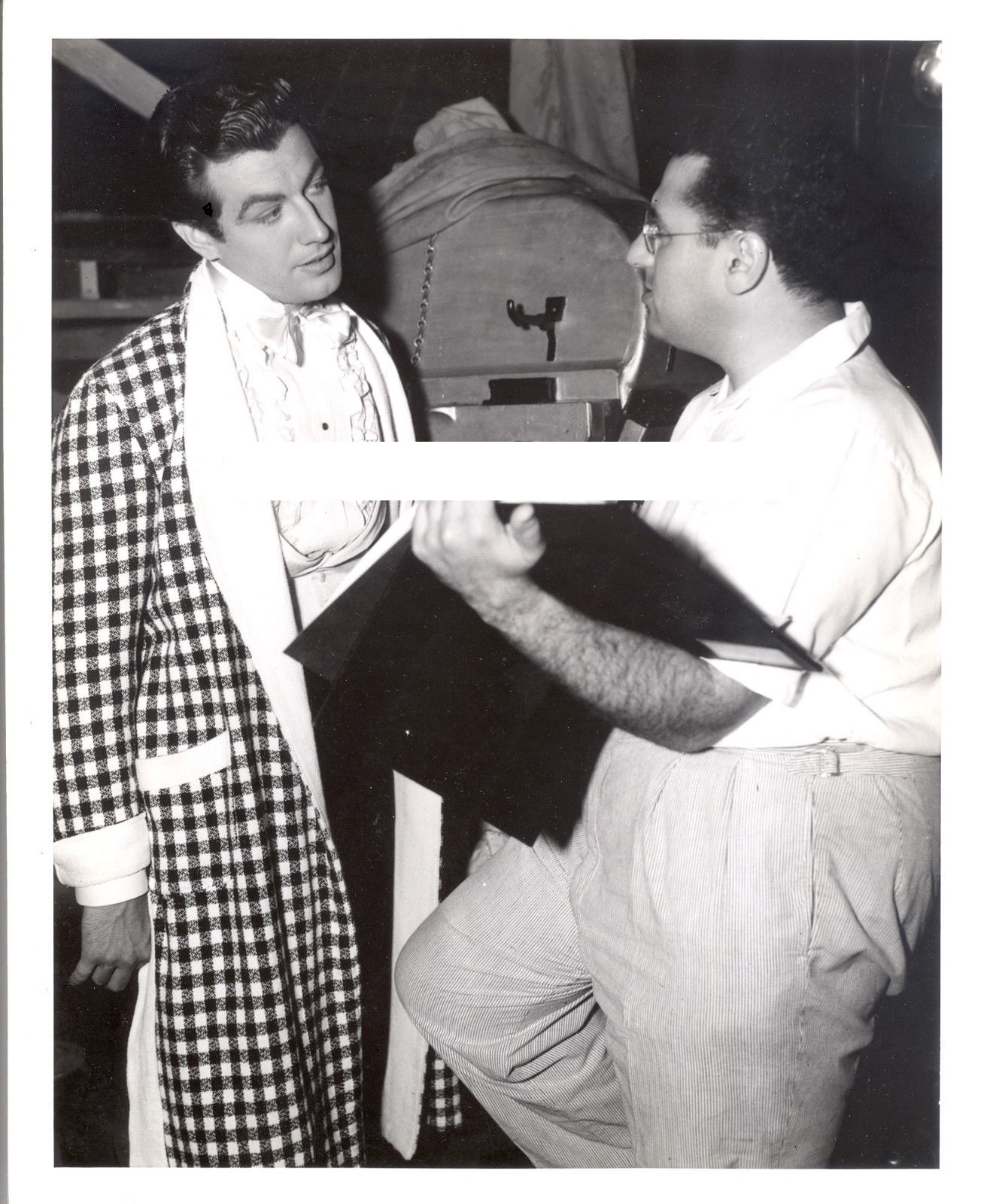
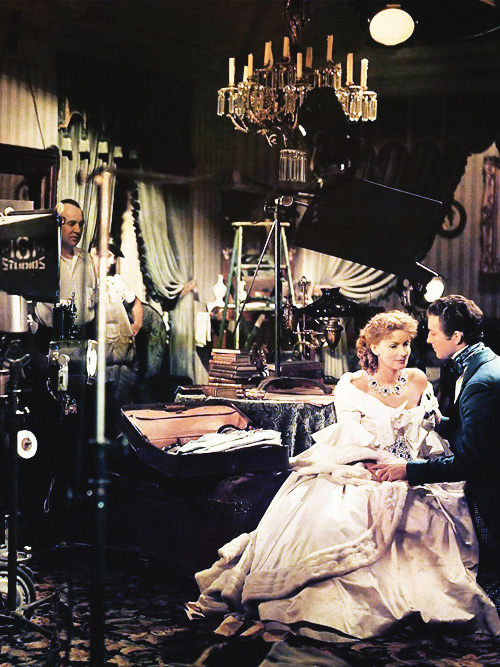
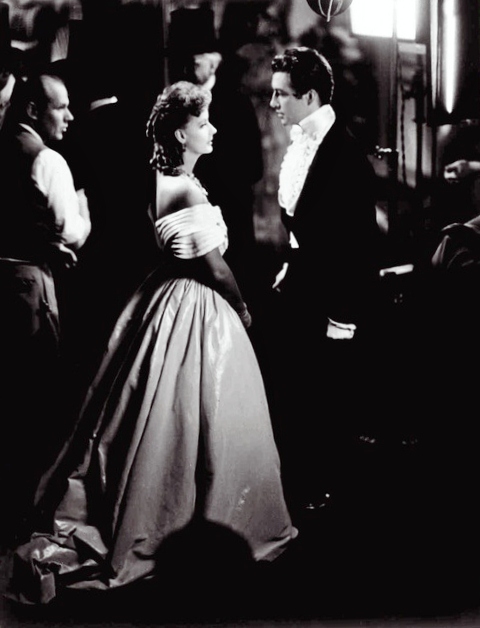
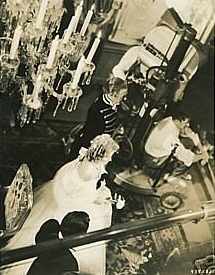
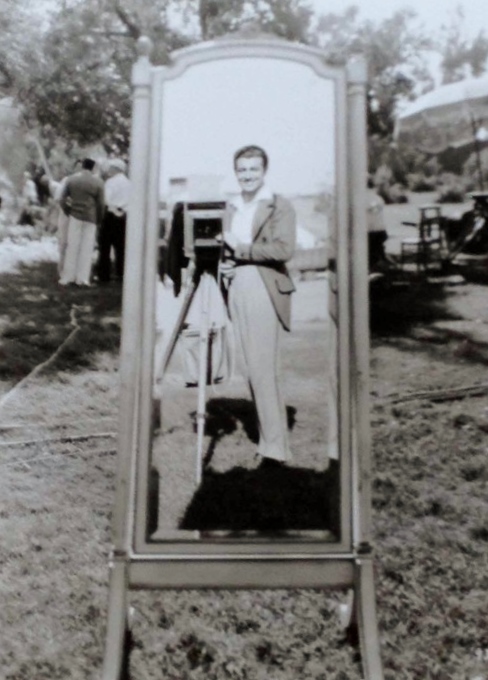
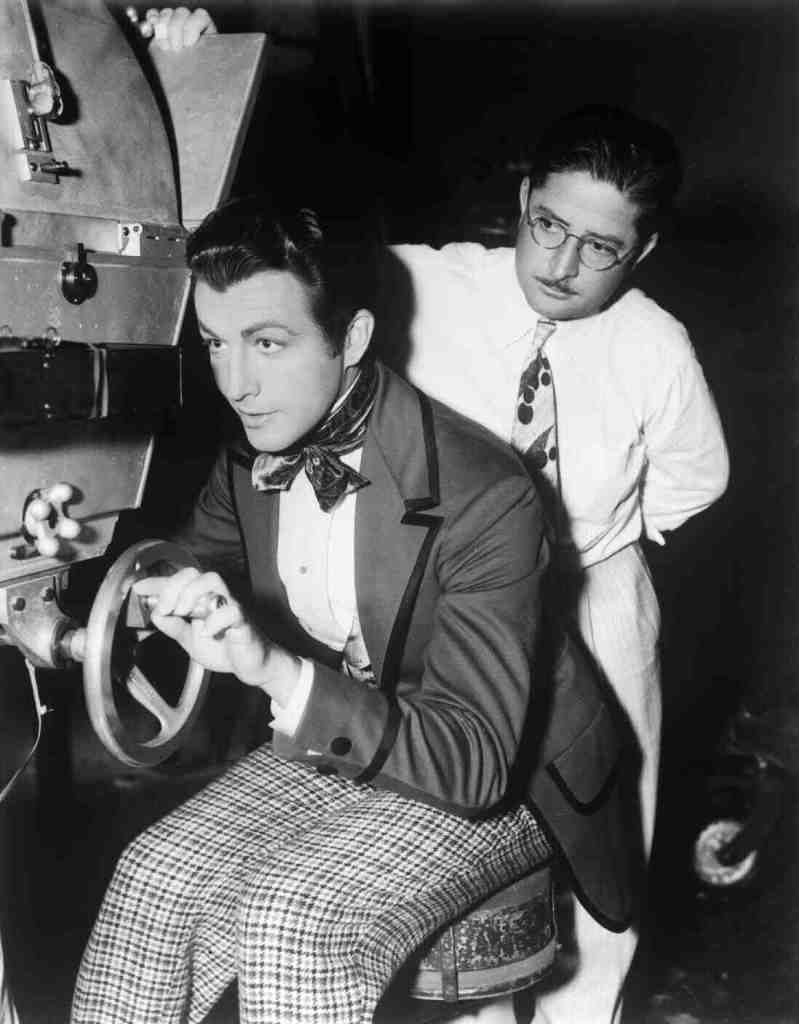
Behind the scenes photos from Camille: The heavy set man in several pictures is Director George Cukor.
This film further proves that the assembly-line system of Hollywood studios back then should also be taken seriously in terms of artistry. Just because movies were produced run-of-the-mill doesn’t mean that they weren’t paid critical attention to by their makers. The usual impression on studio-era Hollywood is: take a formulaic narrative style, maybe adapt a stage play for the screen, blend in a handful of stars from the stable and the films rake in the profit at the box office. Not quite, that’s the easy perception. George Cukor, another of those versatile directors, made it apparent with Camille that filmmaking as an art may still flourish despite (and even within) certain parameters. Camille is beautiful, in so many respects. And it’s not just because of Greta Garbo.
Sure, the acting is amazing, the casting is perfect. Garbo is luminous, mysterious, cruel, and weak at the same time. Robert Taylor surrenders himself to be the heartbreakingly young and vulnerable Armand. Henry Daniell’s coldness and sadism is utterly human and familiar. The others are just plain wonderful. The writing contains so much wit and humor, devotion and pain – but it never overstates anything. The rapport and tensions between lovers, friends, and enemies are palpable and consistent. The actions flow so naturally, just like every scene, that checking for historical inconsistencies seem far beside the point.
here is so much that I love about Camille that it’s hard to enumerate them all, but with every little discovery comes the realization that this is “but” a studio production, so it makes the experience more exquisite. Camille is a gentle, poignant romantic movie that, like Garbo, takes its place delicately and self-effacingly in the history of American cinema, but makes itself indelible in the heart and mind of the lovelorn individual viewer. Review by tsarevna for the IMDb.
Behind the scenes photos from Camille: The heavy set man in several pictures is Director George Cukor.
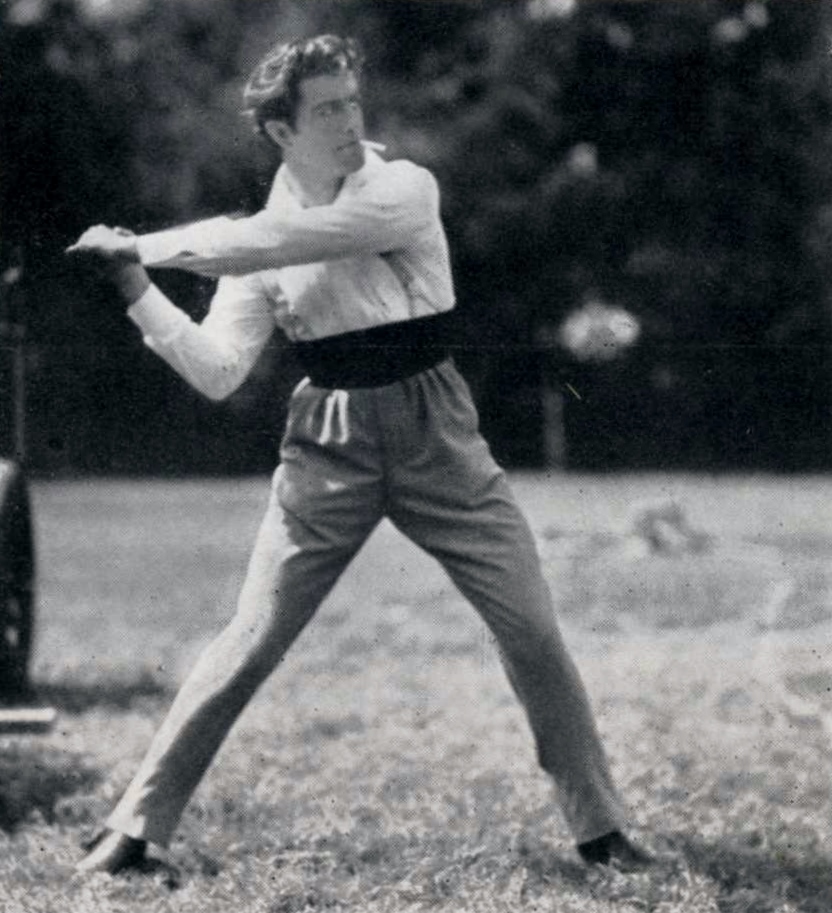
He also plays baseball-in costume on the set.
1936
1936
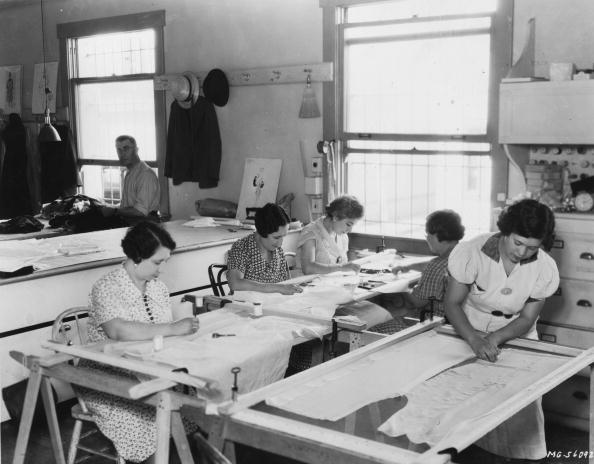
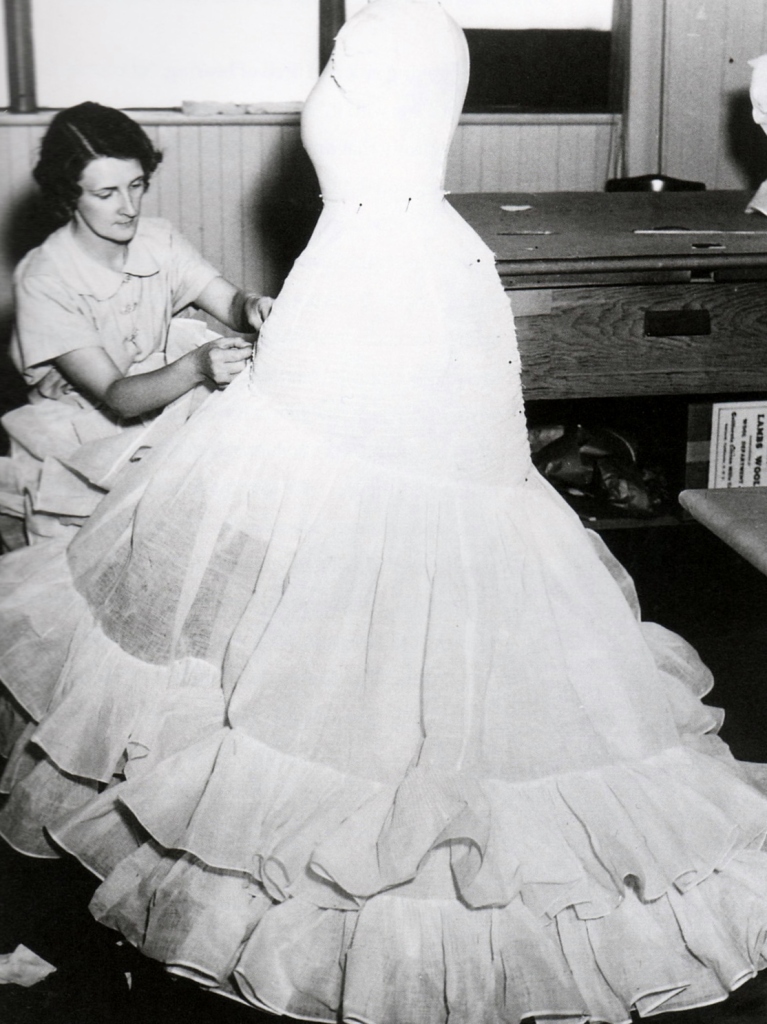
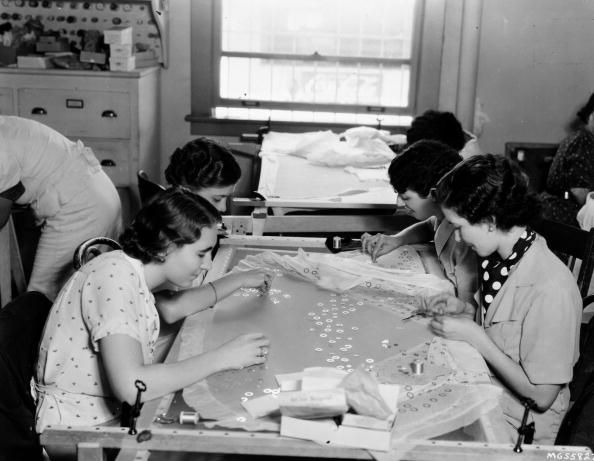
Making Marguerite’s dresses:
1936: A dressmaker working on one of Greta Garbo’s dresses for the MGM film ‘Camille’ which were designed by Adrian. (Photo by Hulton Archive/Getty Images)
circa 1936: Seamstresses at work cutting and sewing a dress to be worn by actress Greta Garbo in the film ‘Camille’. (Photo by Hulton Archive/Getty Images)
circa 1936: Seamstresses working on a dress to be worn by Greta Garbo in the MGM film ‘Camille’. (Photo by Hulton Archive/Getty Images)
September is a good month for Robert Taylor movies in the USA. 9 films will be playing on Turner Classic Movies
“Buried Loot,” 1935, is playing on Turner Classic Movies on Saturday September 4 at 11:30 a.m.
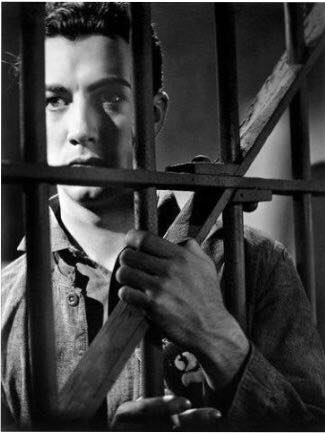
“Buried Loot” was the first in a series of quarterly MGM short subjects called Crime DoesNot Pay. The series ran until 1947. None of the actors were credited. After “Buried Loot” the movie-going public began to ask who the handsome young leading actor was. The Astudio noticed the volume of letters and realized that they had a hot property on their hands. Robert Taylor’s career took off from there with such films as MagnificentObsession (1935) and Camille (1936).
In “Buried Loot,” a young bank clerk embezzles $200,000 then confesses to his boss. He is sent to prison but not before burying the money to enjoy after his release. A cellmate talks the clerk into escaping. I won’t spoil it by telling the rest.
A DVD set of the whole Crime Does Not Pay series is available from Warner Archive and other online retailers.

















 Robert Taylor Actor