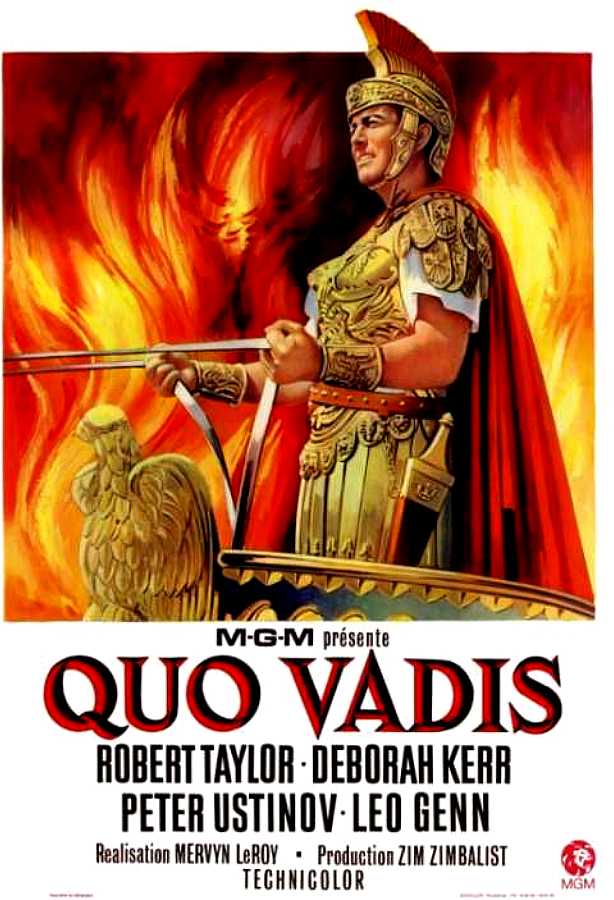
Quo Vadis, 1950, Is Playing on TCM on October 1(USA)

The epic Quo Vadis, 1951 is playing on Turner Classic Movies on Friday, October 1 at 2:30 a.m.  If you haven’t seen this, you’ve missed something truly special.
The 1st century Roman Empire, the fire of Rome, early Christianity, martyrdom…this historical content was dealt with in many films before and after 1951. Yet, it is LeRoy’s Quo Vadis most viewers associate with the infamous period of Roman history, the reign of Nero (A.D. 54-68). Why? There are, I think, several reasons. One is, definitely, the source, a Noble Prize winner novel by Henryk Sienkiewicz. The Polish writer, being an acknowledged historian, contained detailed historical facts and a vivid fictitious story in his novel. As a result, Quo Vadis is a universal masterpiece, absolutely worth reading for anyone. But, since the film, though an adaptation of the book, skips many events or even characters, we may treat Mervyn LeRoy’s Quo Vadis as a separate Hollywood production. In this respect, the movie is also well known as a gigantic spectacle with great cast, lavish sets, crowds of extras, which constitutes a magnificent journey to ancient Rome, the Rome which was on the verge of becoming “Neropolis”. Then, a viewer does not have to know the novel and will enjoy the film.

THE STORY: If we consider Quo Vadis? as an entertaining movie only (which is, of course, a limited view), then anyone more acquainted with cinema will find much in common with Cecil B DeMille’s great epic The Sign of the Cross (1932). Yet, comparison does not work that well concerning the perspective of Quo Vadis (1951). After deeper analysis of the films, a lot of differences occur. While DeMille’s film based on Wilson Barret’s play shows early Christianity in Rome, it foremost concentrates on the clash between the new religion and the Roman order being put in danger. LeRoy’s movie, since based on Henryk Sienkiewicz’s, focuses on the undeniable victory of Christianity. Marcus Vinicius (Robert Taylor) at first finds a new faith meaningless. He has reasonable arguments from the Roman point of view (what about slaves, conquest, enemy treating, etc). Yet gradually, thanks to love for Lygia (Deborah Kerr) and the courageous faith of the martyrs, he shouts out with confidence “Christ, give him strength!” The story of Nero and “the imperial companions” is also much more developed. Yet, Nero (Peter Ustinov) is not only the one who heads for delicious debauchery but also wishes the crowd to have one throat that could be cut. He is an artist who burns Rome in order to create a song. He is a coward who blames the innocent for his own guilts. He is a cynic who collects tears in a weeping phial after the death of his “best friend” Petronius (Leo Genn). Finally, he is a lunatic who praises his “divine ego” and screams at his death seeing no future for Rome without him.

CAST: Anyone who has seen ancient epics must admit that most of them can boast great performances. Nevertheless, I believe that Quo Vadis is one of the top movies in this matter. Robert Taylor and Deborah Kerr are a gorgeous couple portraying a Roman leader  and a Christian girl. Taylor naturally expresses a change of heart. Kerr appealingly portrays innocence, gentleness and true love. Leo Genn is excellent as Petronius, a man of art and elegance who is fed up with Nero’s “secondary songs and meaningless poems.” Peter Ustinov gives a fabulous performance as Nero combining all wicked features of his character. I also loved Patricia Laffan as lustful empress Poppaea with her two pet leopards. There is no milk bath of hers, she does not imitate Ms Colbert but Laffan’s Poppaea is foremost a woman of sin, a woman of lust, and a woman of revenge. The Christians, except for a number of extras, are portrayed by very authentic-looking actors: Abraham Sofaer as Paul and Finlay Currie as Peter…not more to say than that they look identical to the old paintings.

SPECTACLE: The movie is a visually stunning epic that can be compared in its magnificence to Ben Hur (1959) and even Gladiator (2000). There are numerous breathtaking moments: arena scenes, lions, bull fighting, triumph in the streets, and foremost the fire of Rome. We see the real horror within the walls of the burning city. A moment that is also worth consideration is Vinicius hurrying to Rome on a chariot being chased by two other men. When he comes nearer, we see the red sky… The authenticity is increased by a lovely landscape of Cinecitta Studios near Rome where the film was shot. For the sake of spectacle, I went once to see Quo Vadis on a big screen in cinema and felt as if I watched a new film made with modern techniques. It was a wonderful experience.

All in all, I think that Quo Vadis by Mervyn LeRoy is a movie that has stood a test of time. Although it is 55 years old, it is still admired in many places of the world. It’s one of these movies that are the treasures of my film gallery. Not only a colossal spectacle, not only great performances but a very profound historical content at which Henryk Sienkiewicz was best.

Quo Vadis Domine? Where are you going, Lord? These are the words that Peter asked Christ while leaving Rome. After the answer that Peter heard from his Lord, he turned back… in order to proclaim peace to the martyrs and to be crucified. Yet, where once stood decadent “Neropolis” now stands the Holy See where people yearly pilgrim to the tombs of the martyrs and where the blessing “Urbi et Orbi” is goes to all the corners of the world. Sienkiewicz writes about it in the touching final words of the novel. Yet, LeRoy changes it a bit in the film…

A small group of Christians who survived, including Lygia and Marcus, are on a journey. But after a short stop at the place where Peter met Christ, the journey seems to turn into a pilgrimage towards “the Way, the Truth and the Life”   Review by Marcin Kukuczka from Cieszyn, Poland for the IMDB

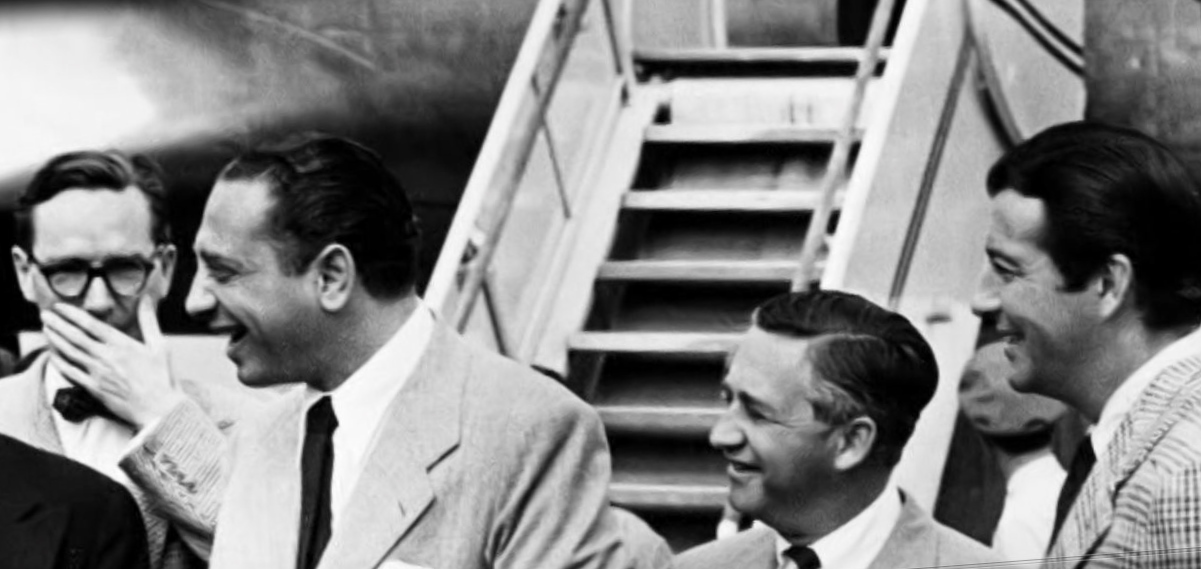
Robert Taylor, Deborah Kerr and Mervyn LeRoy touring Rome:

1950
1950


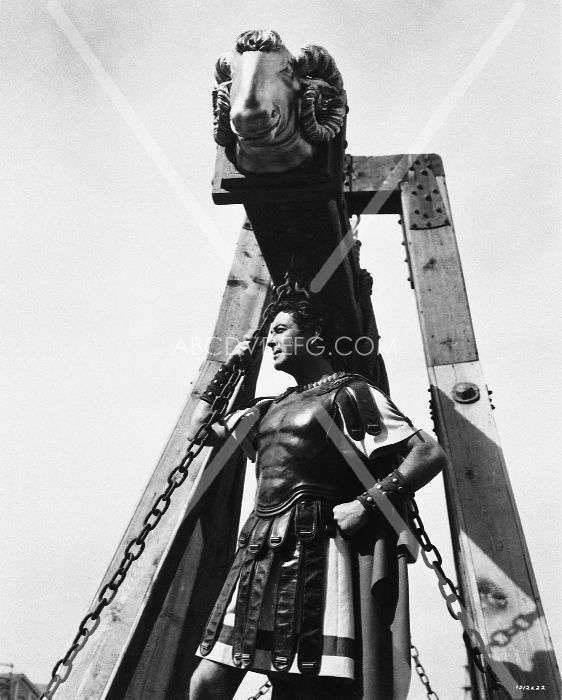
Some behind the scenes photos:

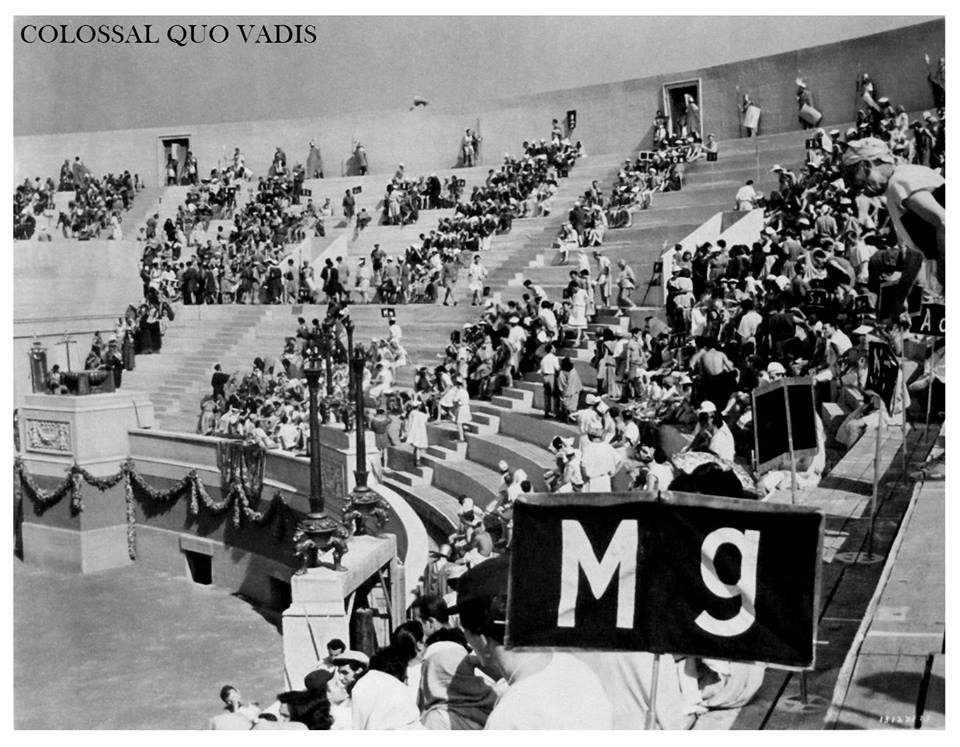
Circus Maximus Set
Robert Taylor reading about Tyrone Power
Marina Berti, Robert Taylor
Sam Zimbalist, far left, Mervyn LeRoy, in chair.
Robert Taylor, Peter Ustinov, Barbara Stanwyck, Patricia Laffan
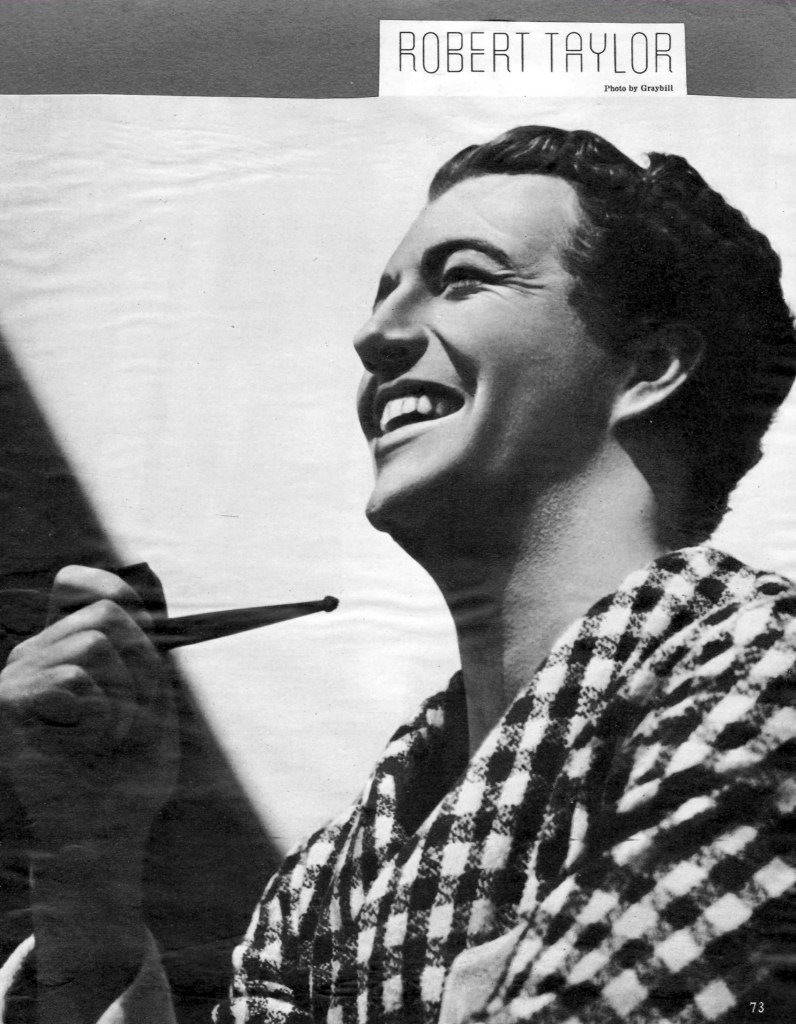
Robert Taylor
Obeying the rules.
Premiere after party: Robert Taylor, Elizabeth Taylor
Comparing footwear: Norman Wooland, Deborah Kerr, Barbara Stanwyck, Robert Taylor.


Posted in Films | Tagged , , , , , , , , , , , , , , , | Leave a comment

Westward the Women, 1951, Is Playing TCM on Sept. 19 (USA)

Westward the Women (1951) is playing on Turner Classic Movies on Sunday, September 19 at 12 noon.

4410
Robert Taylor and John McIntire interview the women who want to go West.

John McIntire approaches wagonmaster Robert Taylor with an interesting job and challenge. He wants to bring brides west to the settlement he’s founded in [California]. Taylor hires on a bunch of hands to escort the women and issues a no fraternization policy. When one of them tries to rape [a woman], [Taylor] shoots him out of hand. It’s the unsettled frontier and as wagonmaster he’s the law on that train as much as a captain on a ship at sea. Of course the hands mutiny and strand Taylor, McIntire, cook Henry Nakamura and the women.

This was a perfect western film for the post Rosie the Riveter generation. No reason at all why women couldn’t deal with the rigors of a wagon train. Of course it helped to have the formidable Hope Emerson along.

Of course men and women will be men and women and Taylor breaks his own no fraternization policy with Denise Darcel. Of course this is away from the train when Darcel runs off.

William Wellman delivers us a no frills unsentimental western with gritty performances by Robert Taylor and the rest of the cast. In a bow to his colleague John Ford, Wellman does have a courtship dance at the settlement. I liked the use of the fiddle music playing “Believe Me With All Those Endearing Young Charms” and “Drink to Me Only With Thine Eyes.”: Ford couldn’t have staged it better.

Henry Nakamura had made a big hit in MGM’s “Go For Broke” about the Nisei division in Italy. He was a funny little guy, I’m not sure he was even five feet tall. I loved the scene when he and Taylor find a stash of buried liquor and proceed [to go] on a toot. This was his last film though, roles for Oriental players were hard to come by. I wonder whatever happened to him.

If you like traditional cowboy films, this one ain’t for you, but given the constraints of 19th century society for the role of woman Westward the Women is quite a revelation. Review by bkoganbing from Buffalo, New York for the IMDb..

Some behind-the-scenes photos:

Director William Wellman and Robert Taylor
Robert Taylor outside of his dressing room.
Actress Polly Burson and Robert Taylor
Mr. Voss, sound technician and Robert Taylor
Set.
Filming.


Posted in Films | Tagged , , , , , , , | 3 Comments

I Love Melvin, 1953, Is Playing on TCM on Sept. 16 (USA)

I Love Melvin, 1953, is playing on Turner Classic Movies on Thursday, September 16 at 10:00 p.m.

Okay, I Love Melvin isn’t a Robert Taylor movie.  It is a fun movie with a delightful cameo by Mr. Taylor.

RT6288
Robert Taylor and Debbie Reynolds in “I Love Melvin.”

This film is an absolute delight from the pre-credit sequence where Debbie Reynolds writes the title of the film in lipstick on a mirror to the hilarious chase through Central Park at the end. In between Debbie dreams of becoming a Hollywood star in some magnificently staged dream sequences, thanks to the genius of Cedric Gibbons, in one of which she meets Robert Taylor as Robert Taylor! In another sequence she dances with three dancers in Fred Astaire masks and three in Gene Kelly masks – before winning an Oscar! Great stuff.

Debbie is perfect as both great movie star and girl next door. Her Broadway performance as a football is a riot. Equally good is Donald O’Connor as her lover and aspiring photographer. His roller-skate sequence is brilliant, as is a dance sequence in which he travels the world and plays numerous characters (again thanks to Gibbons). There is great support from Allyn Joslyn, as Debbie’s exasperated father, and from Jim Backus as a crabby photographer. And the little girl has a good song too.

The score is jazzy and upbeat, and it’s great to see the real Central Park and other New York locations, shot in gorgeous technicolor. I think this terrific musical is very under-rated.
Review by David Atfield (bits@alphalink.com.au) from Canberra, Australia for the IMDb.

ist2_3198263-decorative-swirl-motif

Trivia: Howard Keel was to have originally been the star in Judy (Debbie Reynolds)’s dream, but Keel and his song “And There You Are” were cut after previews and replaced with a brief scene between Reynolds and ‘Robert Taylor’.

Posted in Films | Tagged , , , , , , , | Leave a comment

A Yank at Oxford, 1938, Is Playing on TCM on Sept. 15 (USA)

A Yank at Oxford, 1938, is playing on Turner Classic Movies on Wednesday, September 15 at 3:30 a.m.

RT6528

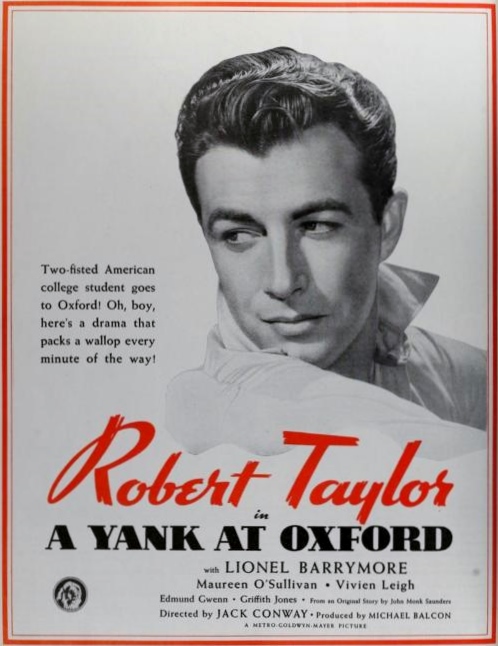
A Yank at Oxford is one of several films intended to “toughen up” Robert Taylor’s image after his success in a number of boudoir romances. Taylor plays Lee Sheridan, a college boy who has been spoiled rotten by his newspaper owner father, played by Lionel Barrymore. Father Sheridan’s habit of holding the presses for Lee’s latest athletic triumph has only contributed to the boy’s swollen head.

Despite his lack of academic focus, Taylor is offered a place at Oxford. Upon his arrival, he immediately encounters a group of his fellow students, who begin a campaign to humiliate him. He also meets the leading lady, Maureen O’Sullivan.

The rest of the delightful and humorous picture focuses on the relationships among three people: Taylor and O’Sullivan, boyfriend and girlfriend; Taylor and Griffith Jones, his leading tormentor; O’Sullivan and Jones, brother and sister. A nymphomaniac Vivien Leigh adds spice to the mix.

A Yank at Oxford allows Robert Taylor to show that he is not only a fine actor but also a fine athlete. Granted that the script specified that he would always win, Taylor is believable as a runner and as a rower. He can also swim.

O’Sullivan is a charming coed torn between her boyfriend and her loyalty to her brother. Jones and Taylor cover up for one other for different peccadilloes. They evolve from antagonists to teammates to friends. A remarkable scene that deserves special mention concerns the venerable English tradition of “debagging.”

The cast is uniformly good. Taylor looks and acts younger than his twenty-seven years. Jones is one of a fine contingent of British actors including Edmund Gwenn, Robert Coote and Edward Rigby. Lionel Barrymore shines as the older Sheridan. A pre-Scarlett Vivien Leigh is lovely and engaging.

A Yank at Oxford was MGM’s first British-made film. Jack Conway, the American director keeps things moving at a brisk pace. Harold Rosson’s photography has a newsreel-like immediacy. And Oxford, of course, looks wonderful. Review by me for the IMDB.

1938

Some behind the scenes photos:

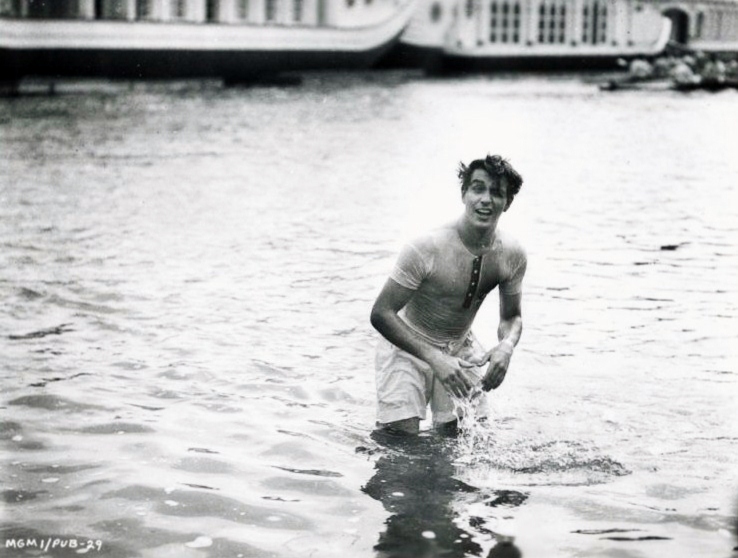
Wet and cold Robert Taylor
1937
Griffith Jones, Maureen O’Sullivan, Robert Taylor
Dir. Jack Conway & producer Michael Balcon on set of film A Yank at Oxford, starring Robert Taylor filming in England.
William Powell, Maureen O’Sullivan, Robert Taylor, Griffith Jones
Robert Taylor and Edmund Gwenn, seen here with Director Jack Conway, discussing a scene of MGM British Studios’ “A Yank at Oxford,” in which Maureen O’Sullivan and Lionel Barrymore have leading roles.
Posted in Films | Tagged , , , , , , , , , , | Leave a comment

The Gorgeous Hussy, 1936, Is Playing on TCM on Sept. 14 (USA)

Robert Taylor & Joan in "The Gorgeous Hussy," (Photo colorized)
Joan Crawford and Robert Taylor

The Gorgeous Hussy, 1936, is playing on Turner Classic Movies on Tuesday, September 14 at 7:45 a.m. est.  It’s a story about Washington D.C. It’s about dirty tricks, sleazy operatives, scurrilous personal attacks and lies. The 2020 election?  No, The Gorgeous Hussy.

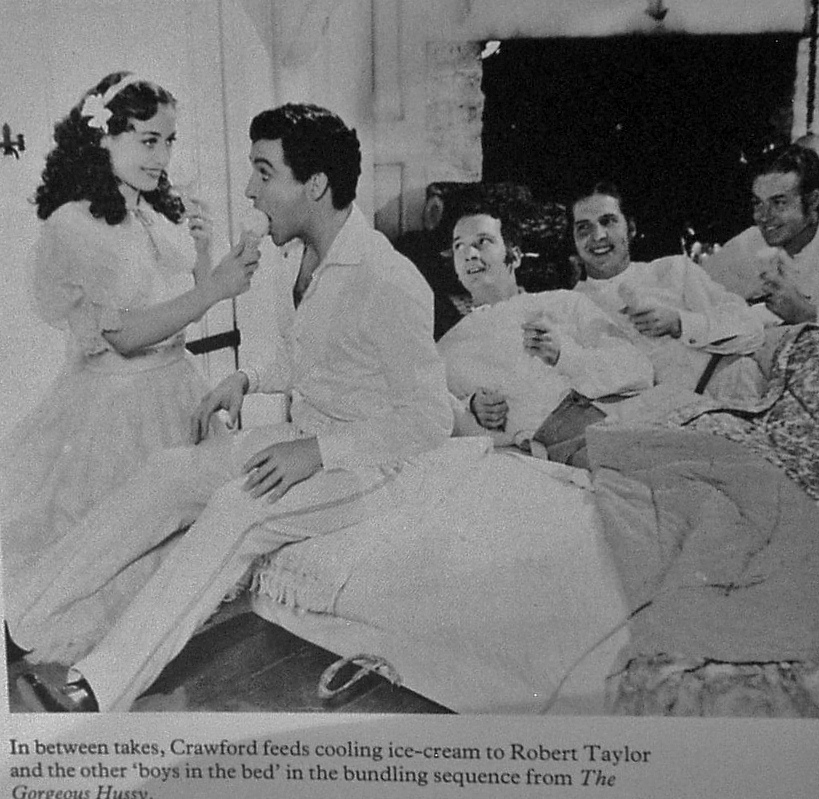
The story centers around Peggy O’Neill, Joan Crawford, an innkeeper’s daughter called“Pothouse Peg,” for her politics and her men. The men are a list of Metro’s best—Robert Taylor, Jimmy Stewart, Franchot Tone, Melvyn Douglas and Lionel Barrymore. Robert Taylor dominates the first quarter of the picture with his enormous energy, his playfulness, his rapport with Crawford and his skin-tight costume. Taylor even sings and dances.

RT2329

After Bow Timberlake’s (Taylor’s) heroic off screen death, things settle down. Andrew Jackson (Barrymore) dominates every scene he’s in. Beulah Bondi, as Rachel Jackson, is equally good. She won an Oscar nomination for her role. Joan Crawford is usually criticized for appearing in an historical picture because she was too “modern.” Here she handles her costumes beautifully, using her skirts to express a range of emotions. While her acting is fine, she is overwhelmed by the male contingent.

Franchot Tone, Crawford’s husband at the time, is quietly effective as Peg’s second husband John Eaton. Melvyn Douglas brings strength and intelligence to his role as Virginian John Randolph. Jimmy Stewart is wasted as Peg’s failed suitor. The Gorgeous Hussy is fun, sometimes moving and a reminder that political behavior wasn’t all that different in the 1820s.  Review by me for the IMDB.

Some behind the scenes photos:

1936
1936-shave
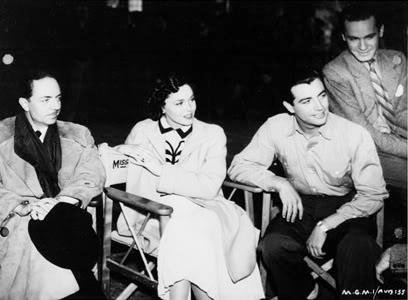
Joan Crawford, Barbara Stanwyck, Henry Fonda, James Stewart
James Stewart, Lionel Barrymore, Robert Taylor, Joan Crawford, Franchot Tone, unknown
Robert Taylor and Joan Crawford playing Parcheesi?
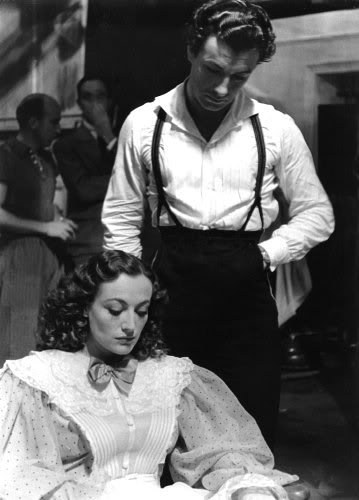
Joan Crawford and Robert Taylor studying the script.

Posted in Films | Tagged , , , , , , , , , , , | 3 Comments