Broadway Melody of 1936, made in 1935, is playing on Turner Classic Movies on Tufesday, November 30 at 2:30 a.m.
Robert Taylor, Eleanor Powell, Jack Benny, Una Merkel. June Knight, Buddy Ebsen, Vilma Ebsen.
Broadway Melody of 1936 is a confection of a movie, meant to sweeten the lives of Depression weary Americans. It stars the unlikely triumvirate of Jack Benny, Eleanor Powell and Robert Taylor. The plot is flimsy, involving the parallel efforts of a columnist (Benny) trying to save his career, a Broadway producer (Taylor) trying to find a star for his new show and a dancer (Powell) trying to get her big break on Broadway.
All this is secondary to the wonderful songs by Nacio Herb Brown and Arthur Freed: “I’ve Got a Feelin’ You’re Foolin’”; “Broadway Rhythm”; “You Are My Lucky Star”; “On a Sunday Afternoon”;” Sing Before Breakfast.” The production numbers for each song range from clever to spectacular. “I’ve Got a Feelin’ You’re Foolin” is sung by Taylor and New York actress June Knight. The special effects are a delight, especially as they are done so long before CGI.
Powell proves, as always, that she is unmatched as a dancer—her energy, grace and strength are a marvel. She dances solo, with Buddy and Vilma Ebsen, with Nick Long, Jr. and with huge choruses.
Nor can the acting be faulted. Jack Benny is excellent as the gossip-obsessed wise-cracking and scheming columnist. Robert Taylor is remarkably poised and mature for his years (24) and even has a nice singing voice. The second banana roles are filled admirably by Sid Silvers and Una Merkel. If Powell and Knight are less impressive when their feet are still, it doesn’t matter—their dancing more than redeems them.
“Broadway Melody of 1936” was a high budget, high gloss, pull out all the stops, MGM production. No expense was spared for the costumes, sets, choreography or photography. The direction by Roy del Ruth is crisp and effective. We could use more films like this in our own difficult times. Review by me for the IMDB.
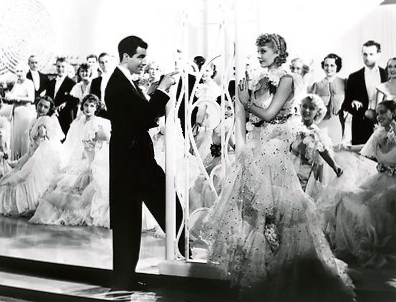
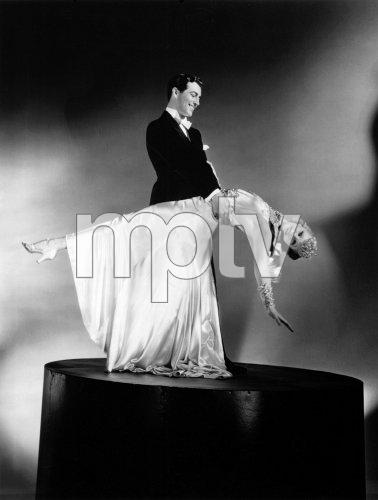
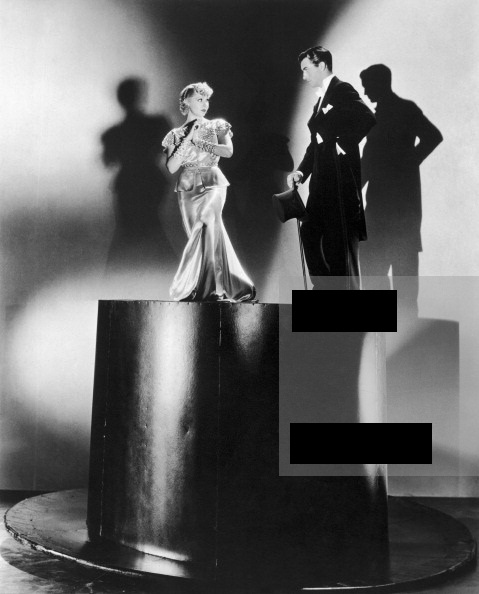
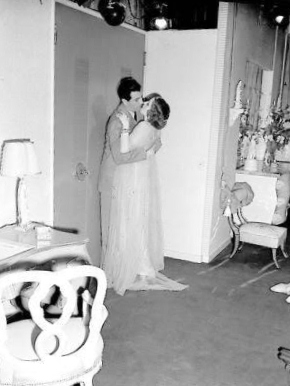
Robert Taylor and June Knight filmed a dance sequence for Broadway Melody of 1936 that did not appear in the final film. These pictures are all that is left.
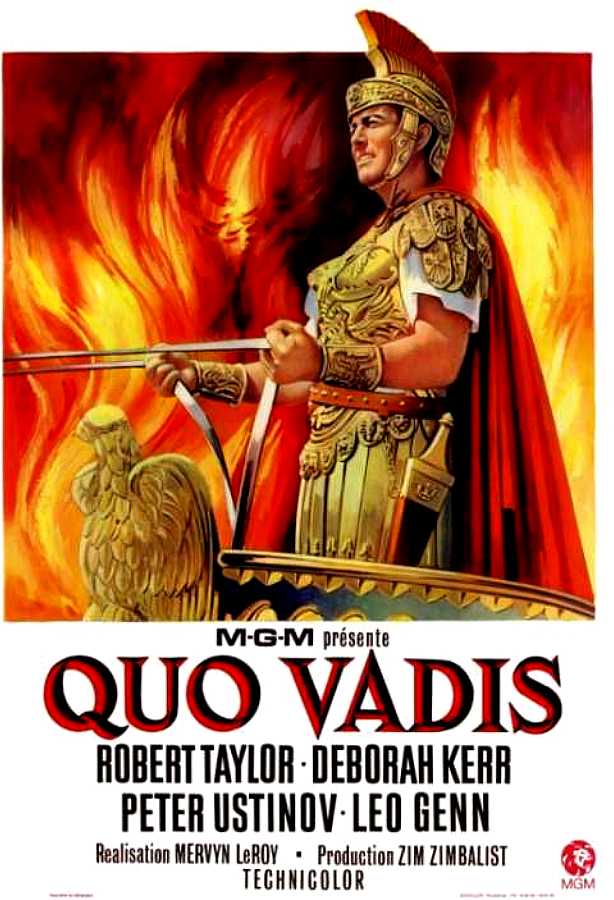
The epic Quo Vadis, 1951 is playing on Turner Classic Movies on Sunday, November 14 at 11:45 a.m. If you haven’t seen this, you’ve missed something truly special.
The 1st century Roman Empire, the fire of Rome, early Christianity, martyrdom…this historical content was dealt with in many films before and after 1951. Yet, it is LeRoy’s Quo Vadis most viewers associate with the infamous period of Roman history, the reign of Nero (A.D. 54-68). Why? There are, I think, several reasons. One is, definitely, the source, a Noble Prize winner novel by Henryk Sienkiewicz. The Polish writer, being an acknowledged historian, contained detailed historical facts and a vivid fictitious story in his novel. As a result, Quo Vadis is a universal masterpiece, absolutely worth reading for anyone. But, since the film, though an adaptation of the book, skips many events or even characters, we may treat Mervyn LeRoy’s Quo Vadis as a separate Hollywood production. In this respect, the movie is also well known as a gigantic spectacle with great cast, lavish sets, crowds of extras, which constitutes a magnificent journey to ancient Rome, the Rome which was on the verge of becoming “Neropolis”. Then, a viewer does not have to know the novel and will enjoy the film.
THE STORY: If we consider Quo Vadis? as an entertaining movie only (which is, of course, a limited view), then anyone more acquainted with cinema will find much in common with Cecil B DeMille’s great epic The Sign of the Cross (1932). Yet, comparison does not work that well concerning the perspective of Quo Vadis (1951). After deeper analysis of the films, a lot of differences occur. While DeMille’s film based on Wilson Barret’s play shows early Christianity in Rome, it foremost concentrates on the clash between the new religion and the Roman order being put in danger. LeRoy’s movie, since based on Henryk Sienkiewicz’s, focuses on the undeniable victory of Christianity. Marcus Vinicius (Robert Taylor) at first finds a new faith meaningless. He has reasonable arguments from the Roman point of view (what about slaves, conquest, enemy treating, etc). Yet gradually, thanks to love for Lygia (Deborah Kerr) and the courageous faith of the martyrs, he shouts out with confidence “Christ, give him strength!” The story of Nero and “the imperial companions” is also much more developed. Yet, Nero (Peter Ustinov) is not only the one who heads for delicious debauchery but also wishes the crowd to have one throat that could be cut. He is an artist who burns Rome in order to create a song. He is a coward who blames the innocent for his own guilts. He is a cynic who collects tears in a weeping phial after the death of his “best friend” Petronius (Leo Genn). Finally, he is a lunatic who praises his “divine ego” and screams at his death seeing no future for Rome without him.
CAST: Anyone who has seen ancient epics must admit that most of them can boast great performances. Nevertheless, I believe that Quo Vadis is one of the top movies in this matter. Robert Taylor and Deborah Kerr are a gorgeous couple portraying a Roman leader and a Christian girl. Taylor naturally expresses a change of heart. Kerr appealingly portrays innocence, gentleness and true love. Leo Genn is excellent as Petronius, a man of art and elegance who is fed up with Nero’s “secondary songs and meaningless poems.” Peter Ustinov gives a fabulous performance as Nero combining all wicked features of his character. I also loved Patricia Laffan as lustful empress Poppaea with her two pet leopards. There is no milk bath of hers, she does not imitate Ms Colbert but Laffan’s Poppaea is foremost a woman of sin, a woman of lust, and a woman of revenge. The Christians, except for a number of extras, are portrayed by very authentic-looking actors: Abraham Sofaer as Paul and Finlay Currie as Peter…not more to say than that they look identical to the old paintings.
SPECTACLE: The movie is a visually stunning epic that can be compared in its magnificence to Ben Hur (1959) and even Gladiator (2000). There are numerous breathtaking moments: arena scenes, lions, bull fighting, triumph in the streets, and foremost the fire of Rome. We see the real horror within the walls of the burning city. A moment that is also worth consideration is Vinicius hurrying to Rome on a chariot being chased by two other men. When he comes nearer, we see the red sky… The authenticity is increased by a lovely landscape of Cinecitta Studios near Rome where the film was shot. For the sake of spectacle, I went once to see Quo Vadis on a big screen in cinema and felt as if I watched a new film made with modern techniques. It was a wonderful experience.
All in all, I think that Quo Vadis by Mervyn LeRoy is a movie that has stood a test of time. Although it is 55 years old, it is still admired in many places of the world. It’s one of these movies that are the treasures of my film gallery. Not only a colossal spectacle, not only great performances but a very profound historical content at which Henryk Sienkiewicz was best.
Quo Vadis Domine? Where are you going, Lord? These are the words that Peter asked Christ while leaving Rome. After the answer that Peter heard from his Lord, he turned back… in order to proclaim peace to the martyrs and to be crucified. Yet, where once stood decadent “Neropolis” now stands the Holy See where people yearly pilgrim to the tombs of the martyrs and where the blessing “Urbi et Orbi” is goes to all the corners of the world. Sienkiewicz writes about it in the touching final words of the novel. Yet, LeRoy changes it a bit in the film…
A small group of Christians who survived, including Lygia and Marcus, are on a journey. But after a short stop at the place where Peter met Christ, the journey seems to turn into a pilgrimage towards “the Way, the Truth and the Life” Review by Marcin Kukuczka from Cieszyn, Poland for the IMDB
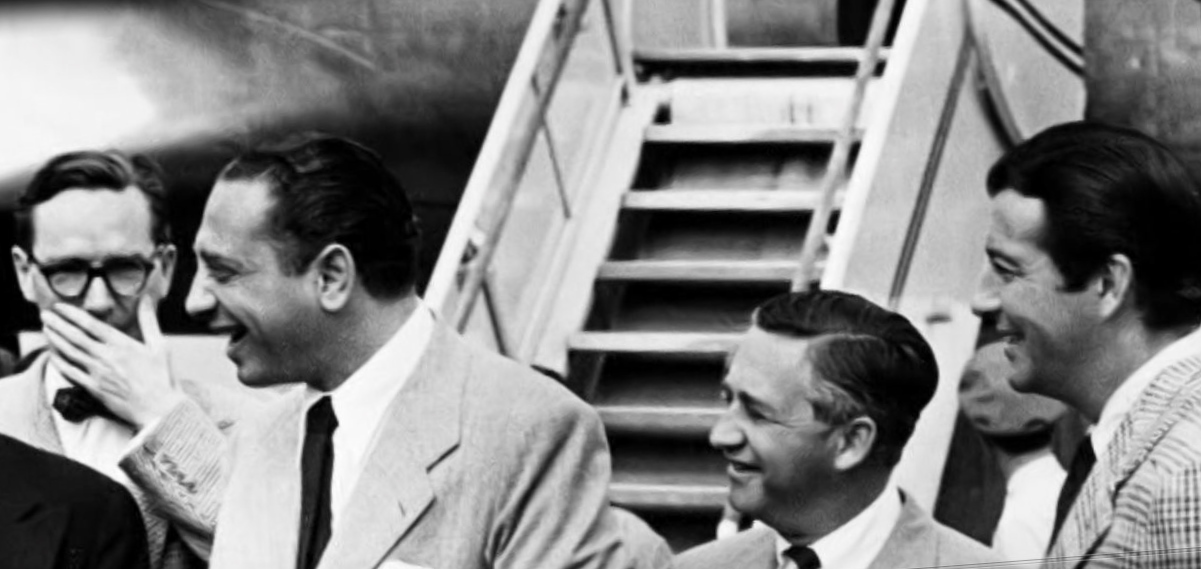
Robert Taylor, Deborah Kerr and Mervyn LeRoy touring Rome:
1950
1950
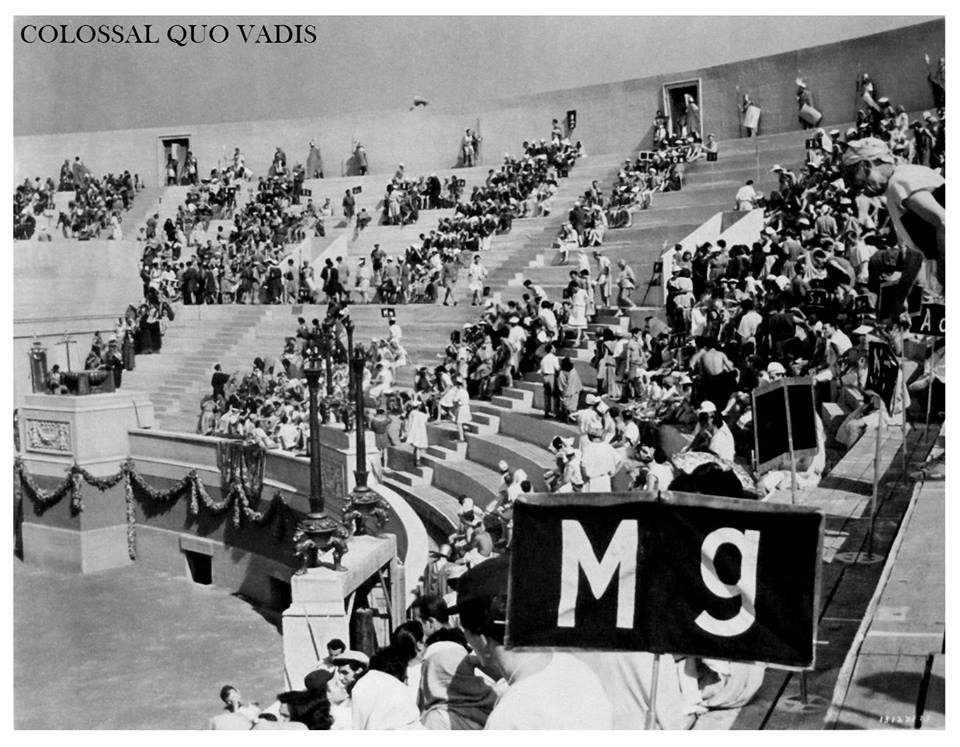
Some behind the scenes photos:
Circus Maximus Set
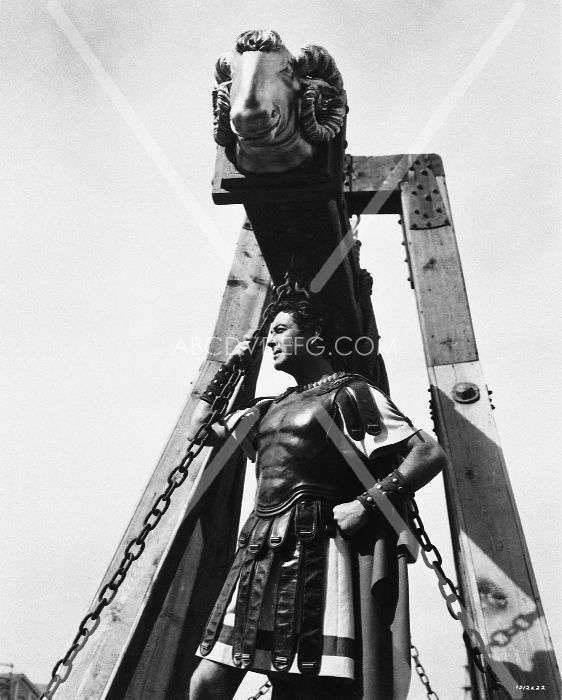
Some behind the scenes photos:
Robert Taylor reading about Tyrone Power
Marina Berti, Robert Taylor
Sam Zimbalist, far left, Mervyn LeRoy, in chair.
Robert Taylor, Peter Ustinov, Barbara Stanwyck, Patricia Laffan
Robert Taylor
Obeying the rules.
Premiere after party: Robert Taylor, Elizabeth Taylor
Comparing footwear: Norman Wooland, Deborah Kerr, Barbara Stanwyck, Robert Taylor.
If you haven’t checked out the Fan Art section of this blog, you should. Just click on the box above with the title Fan Art and you will see an array of excellent work by Fulvia in Rome and Lina in Moscow, including two new works by Fulvia.
If anyone has work they would like displayed in my digital gallery, please contact me through the comments in this blog.
Her Cardboard Lover, 1942, is playing on Turner Classic Movies on Friday, October 8 at 4:30 p.m. est.
Robert Taylor and Norma Shearer in “Her Cardboard Lover,” 1942
What a delight! Robert Taylor is hired by Norma Shearer to be her Cardboard Lover to make her real love, George Sanders jealous. Taylor has been in love with Shearer but has never even spoken to her, too afraid to be rejected. When he finally speaks, he says “I love you” which makes Shearer think he is crazy. Later in the casino he loses $3000 dollars of which he has none, and he is employed by her to work off the debt. George Sanders is a cad but she is in love, and tells Taylor he is never to leave her alone, so that she can rid her mind of Sanders. Every time she tries to get to Sanders, he is there, in the hall, in the bedroom, on the balcony, eating a banana outside the door, totally insane. In one scene when Sanders comes to her bedroom to tell her they can be together if she accepts him as is, Taylor comes out of the bathroom in her pajamas with fluffy slippers and all, and hops into her bed, sending Sanders into a rage. Very, very funny indeed. They argue, he has a fist fight with Sanders, they wind up in jail, but in the end she realizes that it was Taylor all along that she loves, and all ends well. This film comes on the heels of “Johnny Eager” in which Taylor had the best of all roles as the sociopath gangster. Talk about versatility, they should never have sold this great actor short. He could play comedy or drama just as well. The teaming of Shearer and Taylor was their second, coming after “Escape” a pre-war drama about Nazi Germany. They are great together, and it is a shame that this film was Shearers last film. Review by mamalv for the IMDb.
Party Girl, 1958, is playing on Turner Classic Movies on Tuesday, October 5 at 10:15 a.m.
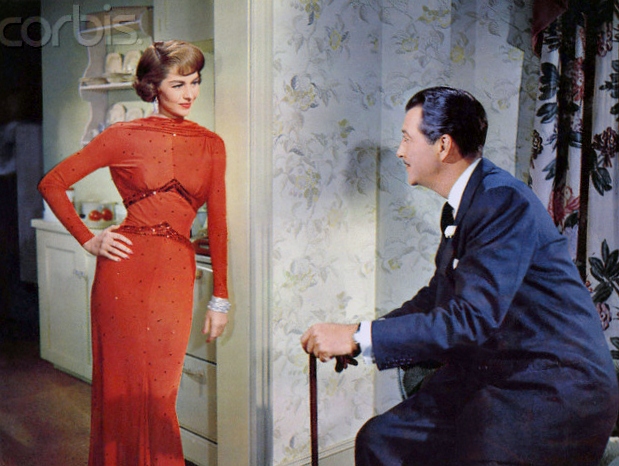
1958 — American actors Cyd Charisse and Robert Taylor on the set of Party Girl, directed by Nicholas Ray.
Nicolas Ray uses color in this movie like some directors use dialogue. It is spectacular to look at with reds and blacks predominate all through the film. It is old-fashioned in it’s appeal to the film noir lover. This is the last film Robert Taylor did for MGM, and it is a great performance. The character of Tommy Farrell is, if you excuse the pun, tailor made for Taylor. Again he is the man with a secret past, as he has been in other film noir classics such as the High Wall, and Rogue Cop, two of his better roles. He is a mob attorney who is drawn to the “fastest way,” which in this case is working for Rico Angelo (Lee J Cobb). Cobb is always wonderful to watch and his role here is one of overstated ignorance, and brutal power. Tommy walks with a limp due to a childhood accident, and hates women because of his ex-wife’s repulsion of his crookedness. She destroyed his masculinity, by denying him access to both her bed and her love. He meets Vicki, played well by Cyd Charisse, at a party given by Angelo, takes her home to find her room mate dead in a bloody tub scene. He is drawn to her, but chases her away telling her “a girl deserves what she can get,” after Vicki wants him to return money given to her by John Ireland at the party.
She follows him to court and watches as he uses his limp to get sympathy from the jury, freeing murderer Ireland. His unique approach also includes the use of an old simple watch that he tells the jury was given to him by his father while he was in the hospital as a boy. It is the secret to his success with the jury. She tells him if that is what he wants “pity” then he has hers. He snarls at her telling her to get out. Afterwards he goes to the club where she is a dancer, every night finally taking her home, and telling her about his past with the wife. They fall in love and that is the beginning of the end for Farrell. She wants him to quit, he can’t. He does go to Europe to have his hip fixed and they vacation, until Rico summons him back to Chicago. There is finds that Rico has a job for him, defending a young gangster who Farrell refers to as a “dog with the rabies.” He tries to leave only to find that Rico will disfigure Vickie if he doesn’t go along. Reluctantly he agrees and in the pursuit there is a massive machine gunning down of the young gangster and his associates.
Farrell escapes unharmed, and goes to Vicki, telling her they must run. She refuses, and the cops take them both to jail. In the end he rats on Rico to save Vicki, he thinks, until he is taken to a broken down meeting hall, where Rico presents Vicki to him, wrapped in bandages. They unveil her still perfect face, but also a bottle of acid, which Rico tells Tommy he will use if he doesn’t take back the testimony. The cops were tipped where to find Rico, and they attack the hall with a hail of bullets causing Rico to tip the acid on his own face, falling to his death through a plate glass window. Vicki and Farrell leave, meeting the District Attorney on the way, with Farrel giving his watch to Kent Smith, “as a remembrance.”
The wonderful thing about this performance by Taylor is that his looks only add to the sadness of the character, his blue eyes showing the conflict within this man. Still magnificent to look at we feel for his plight with the crooked body, not be able to love again until Charisse loves him as is. Taylor is just great here, a mature, restrained Tommy Farrell, in love at last but conflicted about his job, and how he gets his money. A must see film noir. Revew by Mamalv, United States for the IMDB.














 Robert Taylor Actor