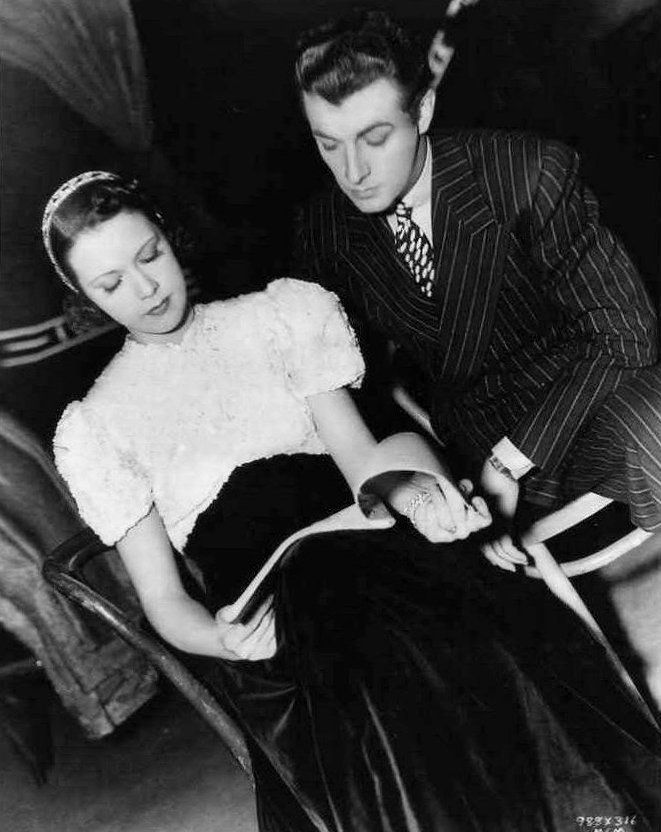
To the followers of this blog, please accept my apology for not keeping up to date with Robert Taylor movies on TCM. Unfortunately, visiting friends in Maine, I fell and fractured my hip. I was in the hospital for five days before flying back to Florida. Everything you’ve heard about airline travel today is true. My flight was delayed for four hours and then had to fly from New Hampshire to Orlando via Cincinnati. It added an hour to the flight.
Anyhow, I am just now beginning to catch up. I’ve received a treasure of Taylor materials from my friend and fellow fan in Australia and will be sharing them as I can.
The following is from the book Garbo by Robert Gottlieb. New York, Farrar, Straus and Giroux, 2021, pp. 385-386 and 419.
Camille, 1936
There’s something about Garbo’s silences and her concentration that gets you, way down inside. The woman is one of the most powerful personalities in the world. She wears a kind of flat colorless make-up that gives you a suggestion of something out of this world. . . There’s a kind of radiation from her when you’re playing an intense scene that makes you play up to it, whether you have the stuff in you or not. She simply makes you find it and give.
Also: She thought with her eyes, photographically. The muscles in her face would not move, and yet her eyes would express exactly what she needed. Working with her was perhaps my greatest acting lesson, though I probably didn’t learn enough from it.
Camille cost $1, 486,000 to make. It brought in $2,842,000 with a profit of $388,000, or $8,212,000 in 2022 dollars.
Small Town Girl, 1936, is playing on Turner Classic Movies on Monday, June 6 at 12 noon
Robert Taylor and Janet Gaynor
For most of her career Janet Gaynor did nothing but play small town girls, the best known being Esther Blodgett. But I’ve seen her in films like State Fair and Three Loves Has Nancy and it’s the same part, the girl from the tiny hamlet who conquers the big city and the men in it. With a title like this, there was only one casting possibility.
Janet’s a girl who’s thoroughly stuck in a rut in her New England hamlet and yearns for a little adventure. She finds it in the person of Robert Taylor, a young doctor who comes from a wealthy Boston family. After a night’s carousing Gaynor and Taylor are married, to the chagrin of his fiancée, Binnie Barnes and her boyfriend James Stewart.
Remember this is Boston so Taylor’s father Lewis Stone prevails on Taylor to give the marriage a few months trial. Of course this is where the balance of the story comes in. In many ways this plot seems like a harbinger of The Way We Were.
Taylor’s career was now in full swing as Small Town Girl was the next film after his breakout performance in Magnificent Obsession. Remember in that film he was a playboy who became a doctor. Here’s he’s a doctor who doubles as a playboy. Never mind though, feminine hearts all over the English speaking world were fluttering over MGM’s latest heartthrob. My mother who was a juvenile at this time told me that Taylor’s appeal back in these days was just about the same as Elvis’s.
James Stewart was at the beginning of his career as well as MGM had him in about seven features in 1936, mostly in support. Interesting though with worse career management, he could have gone on playing hick roles like Elmer the boyfriend. But it was also obvious there was a spark of stardom with him as well.
Gaynor would leave the screen a few years later, Taylor was at the beginning of his career. He’d have better acting roles in his future, but for now Small Town Girl is a great example of the screen heartthrob he was at the beginning of his stardom. Fans of both stars will like what they see in Small Town Girl. Review by bkoganbing from Buffalo, NewYork
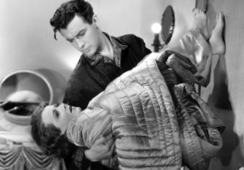
Taylor has Gaynor upside-down.
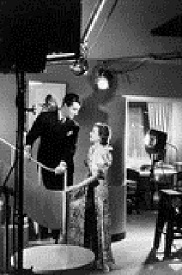
Some behind-the-scenes photos:
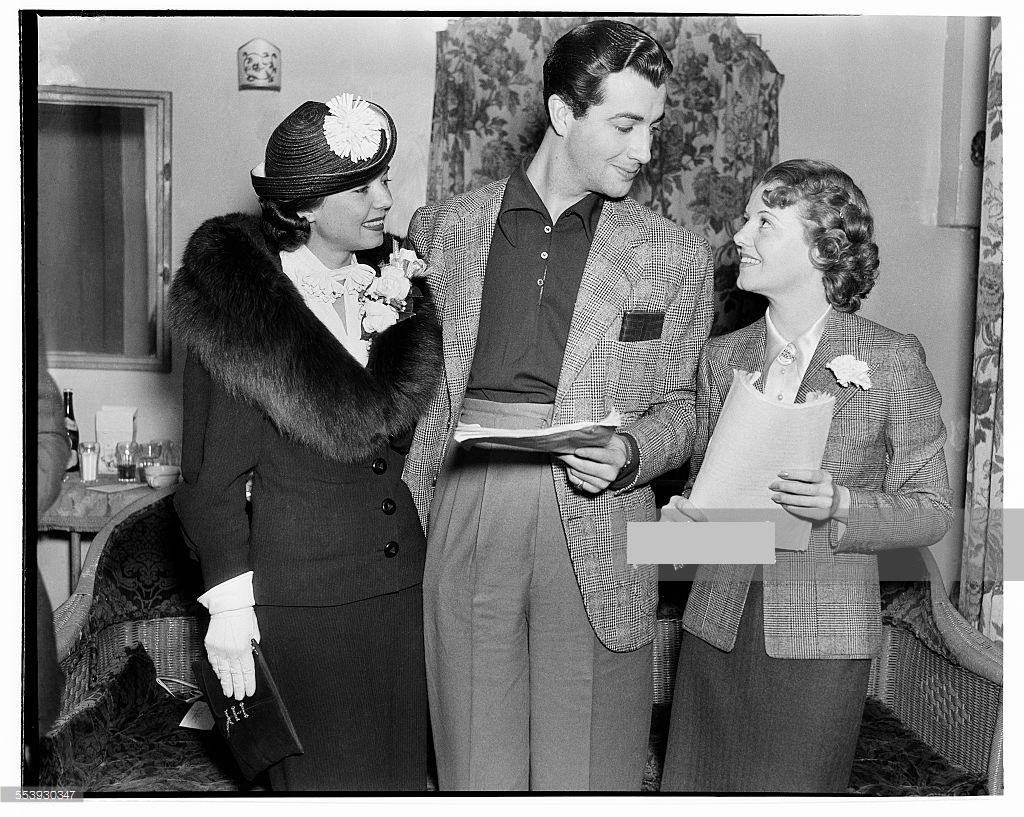
Top to bottom: Robert Taylor and Janet Gaynor taking a break on the set; filming a scene; Taylor and Gaynor with singer Frances Langford.
Broadway Melody of 1938, 1937, is playing on Turner Classic Movies on Friday, June3 at 3 p.m. est The film cost $1,588,000 and made a profit of $271,000 or $4,609,188.57 in today’s money.
Broadway Melody of 1938 is one of those pure escapist type films that folks in the Thirties paid their money to see. It’s a nice film combining both a backstage and a racetrack story with one of the most eclectic casts ever assembled for a film.
What can you say when you’ve got dancing covered by Eleanor Powell, George Murphy and Buddy Ebsen, the varied singing styles of Judy Garland, Sophie Tucker, and Igor Gorin and such incredible character actors as Raymond Walburn, Charley Grapewin, Billy Gilbert, and Robert Benchley. All of them such great performers and such vivid personalities there’s no way that the film could be bad.
Almost lost in the shuffle are Robert Taylor and Binnie Barnes who don’t sing or dance and aren’t colorful. But Binnie Barnes is one fine actress and she’s the villain of the piece as Raymond Walburn’s wife who was once part of the chorus, but wants not to be reminded of from where she came. She’s jealous of Eleanor Powell and has a thing for Taylor, As did half the young women in America in 1937. Though the part doesn’t call for any kind of real acting, Robert Taylor shows every bit as to why he was such a screen heart throb that year. He’s the nice guy producer/director who gets caught in a crunch between his financial backer Raymond Walburn and his wife and the girl of his dreams, Eleanor Powell. Walburn is in the role that Guy Kibbee had in 42nd Street and he does it well with his own avuncular touches.
Powell is not just an ambitious hoofer as are Ebsen and Murphy. She’s also the owner of race horse upon whose performance everyone’s future eventually rides. Just how the racetrack and backstage are woven into the same plot you have to see the film for.
Vocal highlights are provided by Judy Garland who sings her famous Dear Mr. Gable version of that old Al Jolson song, You Made Me Love You. She also sings Everybody Sing which is a number I personally like a whole lot better. Honest Indian.
Sophie Tucker is her mother who owns and operates a theatrical boarding house where half the cast lives. She’s an old trooper herself and of course she gets to sing her famous theme, Some of These Days.
Other material that the MGM songwriting team of Arthur Freed and Nacio Herb Brown did not provide for this film are a couple operatic arias sung by the great concert singer Igor Gorin. He sings Largo Al Factotum from The Barber of Seville and the Toreador Song from Carmen. I’d venture a guess that Louis B. Mayer signed Gorin for this as an effort to keep his other two singers Nelson Eddy and Allan Jones in line. In fact Eddy and Mayer did not get along and Jones would be leaving MGM the following year. Gorin is in fine voice, but did not have much screen presence and has very few spoken lines. I don’t think that was an accident.
Broadway Melody of 1938 is one of MGM’s best musicals from the Thirties and how can you not like a film with as much talent as this one is loaded with. Review by bkoganbing from Buffalo, New York for the IMDb.
Some behind the scenes photos:
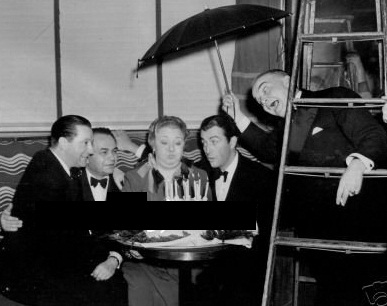
Edward G. Robinson, Sophie Tucker, Robert Taylor
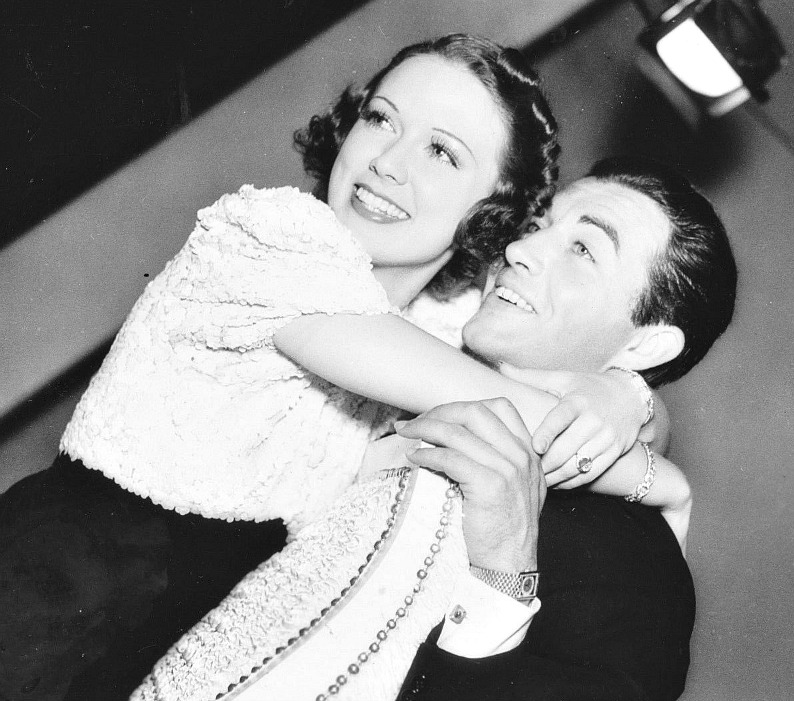
Eleanor Powell and Robert Taylor
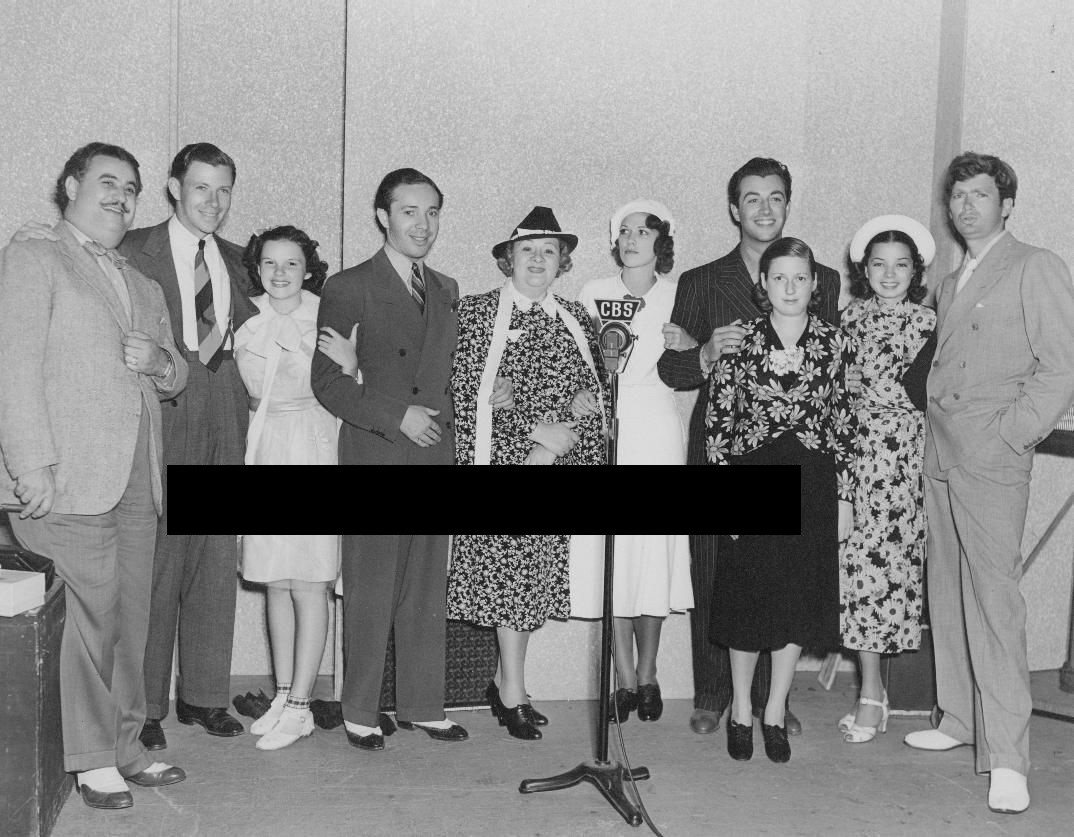
Some of the Above Are George Murphy, Judy Garland, Sophie Tucker, Eleanor Powell, Robert Taylor, Vilma Ebsen, Buddy Ebsen
The Secret Land, 1948, is Playing on Turner Classic Movies on Weddnesday, June 1 at 3:30 a.m.
Land, 1948, is a documentary about Admiral Richard Byrd and his explorations of the Antartic. It is narrated by Cmdr. Robert Montgomery USNR, Lt. Robert Taylor USNR and Lt. Van Heflin AAFR. The film won the Academy Award for Best Documentary Film in 1948.
Here are two synopses:
This documentary, filmed entirely by military photographers, recounts the U.S. Navy’s 1946-47 expedition to Antarctica, known as Operation High Jump. The expedition was under the overall command of Admiral Richard E. Byrd, no stranger to the Antarctic. This was a large undertaking involving 13 ships and over 4000 thousand men. The fleet departed from Norfolk, Virginia traveling through the Panama canal and then southward to their final destination. The trip through the ice pack was fraught with danger and forced the submarine that was part of the fleet to withdraw. The trip was a success meeting all of its scientific goals. The film is narrated by three Hollywood stars, all of whom served in the US Navy: Robert Taylor, Robert Montgomery and Van Heflin (I)’.- Written by garykmcd
This film documents the largest expedition ever undertaken to explore Antarctica. The expedition, code named “Operation High Jump,” was made by the U.S. Navy and involved 13 ships (including one submarine), 23 aircraft, and about 4700 men. The film was shot by photographers from all branches of the U.S. military. One purpose of the expedition was to explore and photograph several thousand square miles of inland and coastal areas that had not been previously mapped. Additionally, military planners wanted to evaluate whether military troops could successfully perform against an adversary in such an environment.- Written by David Glagovsky <dglagovsky@verizon.net>
Robert Taylor in the Navy, with Lucille Ball and Kathryn Grayson, ca. 1943.
and one Review:
Some Real Heroes
Back in the day when documentary film making was more than some obnoxious twit sticking a video camera in front of celebrities and then editing the content for a political agenda, MGM contributed this classic about Admiral Byrd’s post World War II expedition to Antarctica. The film was narrated by three WWII veterans with MGM, Robert Montgomery, Van Heflin, and Robert Taylor.
The men here are assigned some of the most hazardous peace time duty the United States Navy ever had to perform. The polar regions are some of the most forbidding area on our globe. The film captures some real dangers the Navy faced. We see a submarine caught in a frozen ice flow, a rescue of a man being transferred from ship to ship via breecher’s buoy when the line snaps and he’s tossed into the frozen sea, a crash of one of the planes. This film captures all the hazards of the expedition and the forbidding beauty of Antarctica.
From his transatlantic flights and his early polar expeditions Admiral Richard E. Byrd was a genuine American hero. We probably know more about the geography of the polar regions due to his work than any other individual. After this expedition, Byrd in fact did return to the South Pole as late as two years before he died in 1957. Review for the Imdb by bkoganbing (Buffalo, New York).









 Robert Taylor Actor